What Is Black Ice? How It Forms, Looks & Affects Winter Roads
Black ice is a thin, clear or nearly transparent layer of ice that forms on roads, sidewalks, bridges, parking lots, and other surfaces. It is called “black ice” because the dark pavement underneath can remain visible through the ice, making the surface look wet rather than obviously frozen.
That makes black ice especially difficult to notice.
It often forms overnight or during the early morning when moisture from rain, melting snow, fog, or other sources freezes on a sufficiently cold surface.
For families watching winter weather before school, black ice matters because roads can become hazardous even when there is little or no fresh snowfall.
What Is Black Ice?
Black ice is a thin layer of transparent or nearly transparent ice that forms on a road or another transportation surface.
It is not actually black.
The pavement beneath the ice remains visible, so the frozen surface may blend into the road.
Unlike snow-covered roads, which are usually easy to recognize, black ice can be difficult to distinguish from ordinary wet pavement.
That hidden appearance is one reason it can create unexpected winter travel hazards.
Why Is It Called Black Ice?
The name comes from how the ice looks on dark pavement. Black ice is usually clear enough for the asphalt underneath to show through.
A driver may therefore see what appears to be a dark, wet road when the surface is actually frozen. The ice itself is not black.
Depending on lighting, black ice may appear:
- Dark like the road underneath
- Slightly glossy
- Wet-looking
- Smooth
- Reflective under headlights or streetlights
It may also be almost impossible to see under some conditions.
What Does Black Ice Look Like on the Road?
Black ice often looks very similar to wet pavement.
A road may appear dark and slightly shiny rather than white or visibly frozen.
Possible clues include:
- A glossy road surface
- Pavement that looks wet even though there is little tire spray
- Ice on nearby sidewalks or vehicles
- Frost on grass or railings
- Frozen puddles
- Icy patches near bridges
- Shaded areas that remain frozen
- Temperatures near or below freezing after rain or snowmelt
These clues can suggest black ice risk, but they do not guarantee that you will be able to see the ice itself.
The safest assumption is that hidden ice may be present when temperatures and moisture favor freezing.
How Does Black Ice Form?
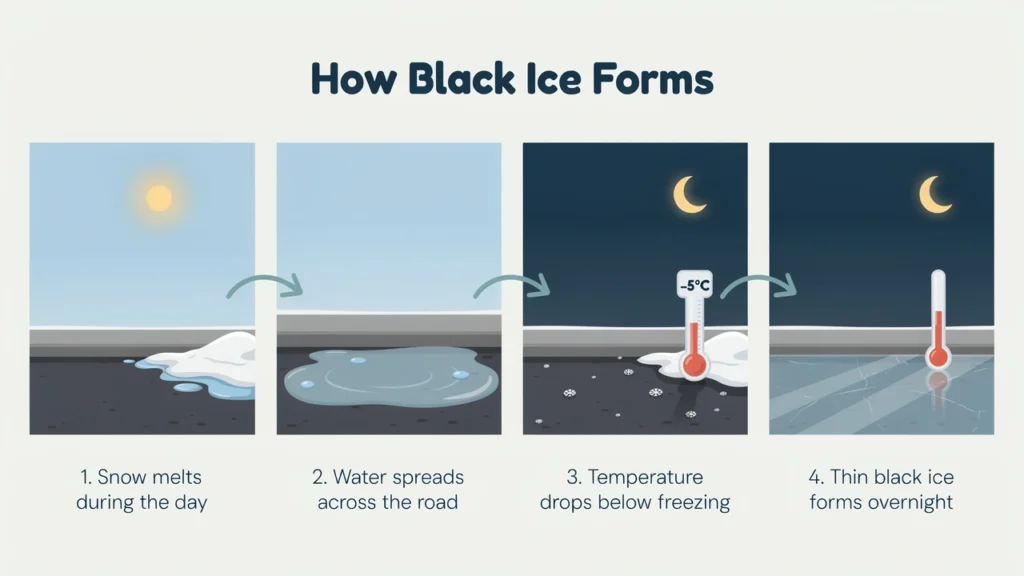
Black ice forms when a thin layer of water freezes on a sufficiently cold surface. The moisture can come from several sources.
Melted Snow Refreezes
This is a common way black ice develops. Snow can melt during the day when temperatures rise or sunlight warms exposed surfaces.
Water from the melting snow may then remain on pavement. If road temperatures fall below freezing overnight, that water can refreeze into a thin layer of clear ice.
This is one reason roads may appear clear after the snow has stopped but still become dangerous before the next morning commute.
Rain Freezes Overnight
Black ice can also form after rain. A road may remain wet after precipitation ends.
If the pavement cools enough overnight, the remaining water can freeze. By morning, the road may look only slightly wet even though a thin layer of ice has developed.
Freezing Rain or Freezing Drizzle
Freezing rain falls as liquid water but freezes when it contacts a sufficiently cold surface. This can create clear glaze ice on roads, sidewalks, vehicles, trees, and other exposed objects.
Black ice on a roadway can therefore be associated with freezing-rain conditions. Freezing rain and black ice are not exactly the same thing, however.
Freezing rain describes precipitation falling from the atmosphere. Black ice describes ice present on a surface.
Fog, Mist and Surface Moisture
Moisture does not always need to come from obvious rain or melting snow. Fog, mist, condensation, or other moisture can sometimes freeze onto a cold roadway.
When that frozen layer is thin and transparent, it may become difficult to distinguish from the pavement underneath.
What Causes Black Ice on Roads?
Black ice generally requires two things:
- Moisture
- A road surface cold enough for that moisture to freeze
Possible moisture sources include:
- Rain
- Snowmelt
- Freezing rain
- Freezing drizzle
- Fog
- Mist
- Condensation
- Water draining across pavement
Once the surface temperature is sufficiently cold, the moisture can freeze into a thin layer. This means black ice can form even after active precipitation has ended.
At What Temperature Does Black Ice Form?
There is no single air-temperature reading that guarantees black ice. The important factor is the temperature of the road surface itself.
Water freezes when conditions at the surface support freezing, but pavement temperature and air temperature are not always identical.
For example, a road surface may remain colder than the nearby air for a period of time.
That means checking only the temperature shown by a weather app may not tell you the complete road condition.
It is better to consider:
- Air temperature
- Recent precipitation
- Overnight temperature
- Road-surface conditions
- Cloud cover
- Sun exposure
- Local winter weather alerts
When Is Black Ice Most Likely to Form?
Black ice is especially concerning during overnight and early morning hours. These are periods when temperatures may reach their lowest point and wet surfaces may freeze.
Common situations include:
- After daytime snowmelt
- After evening rain
- During overnight cooling
- Before sunrise
- During freeze-thaw cycles
- After freezing drizzle
- During foggy freezing conditions
For school travel, the timing is important because these conditions can develop during the same hours when school districts inspect roads and buses begin operating.
Where Does Black Ice Form First?
Black ice can develop anywhere moisture freezes, but some locations deserve extra attention.
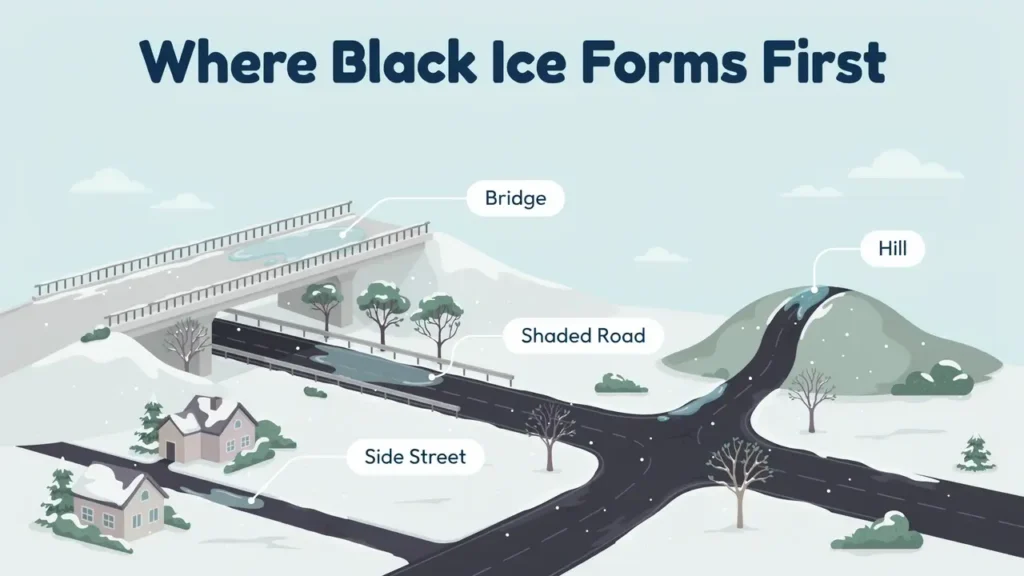
Bridges and Overpasses
Bridges and overpasses can cool differently from ordinary roads because cold air circulates above and below them.
They may become icy while nearby ground-level roads remain wet.
This makes them particularly important during borderline freezing conditions.
Shaded Roads
Roads that receive little direct sunlight may remain colder for longer.
Examples include:
- Roads beneath trees
- Streets between tall buildings
- Mountain roads
- North-facing sections
- Roads next to hills or retaining walls
Shaded areas may therefore remain icy after more exposed pavement begins to thaw.
Residential and Rural Roads
Major highways may receive treatment before smaller roads.
School buses often travel through:
- Residential neighborhoods
- Rural roads
- Side streets
- Hills
- Curves
- Bridges
Conditions on these roads may differ significantly from a nearby main highway.
Low-Lying Areas
Cold air and moisture may collect in certain low spots.
Water can also drain across pavement and freeze.
These areas may create isolated icy patches even when most of a route appears clear.
Why Do Bridges and Overpasses Freeze Before Other Roads?
A ground-level road is in contact with the earth beneath it.
That ground can retain some heat.
A bridge is exposed to air on both its upper and lower surfaces.
As temperatures fall, the bridge deck can cool more quickly under some conditions.
If moisture is present, freezing can therefore begin on bridges and overpasses before it becomes obvious on nearby roads.
This is why winter weather warnings often tell drivers to use extra caution on elevated road surfaces.
How to Spot Black Ice on the Road
Black ice can be difficult or impossible to see clearly.
Instead of relying only on appearance, look for environmental warning signs.
Watch the Road Surface
A section of road that appears unusually glossy, smooth, or dark may be icy.
Under streetlights or headlights, black ice may reflect light differently from dry pavement.
Check Nearby Surfaces
Look for:
- Frost
- Ice on parked vehicles
- Frozen puddles
- Ice-covered sidewalks
- Glazed railings
- Frozen tree branches
If nearby exposed surfaces are frozen, untreated roads may also be at risk.
Pay Attention to Timing
Black ice is more likely when:
- It rained recently
- Snow melted during the day
- Temperatures dropped overnight
- The sun has not risen yet
- Roads remain shaded
- A freeze follows a thaw
Do Not Assume a Clear Road Is a Safe Road
One of the most important points about black ice is that the pavement may look clear.
No snow on the roadway does not necessarily mean there is no winter hazard.
Black Ice vs Wet Road
Black ice and wet pavement can look remarkably similar.
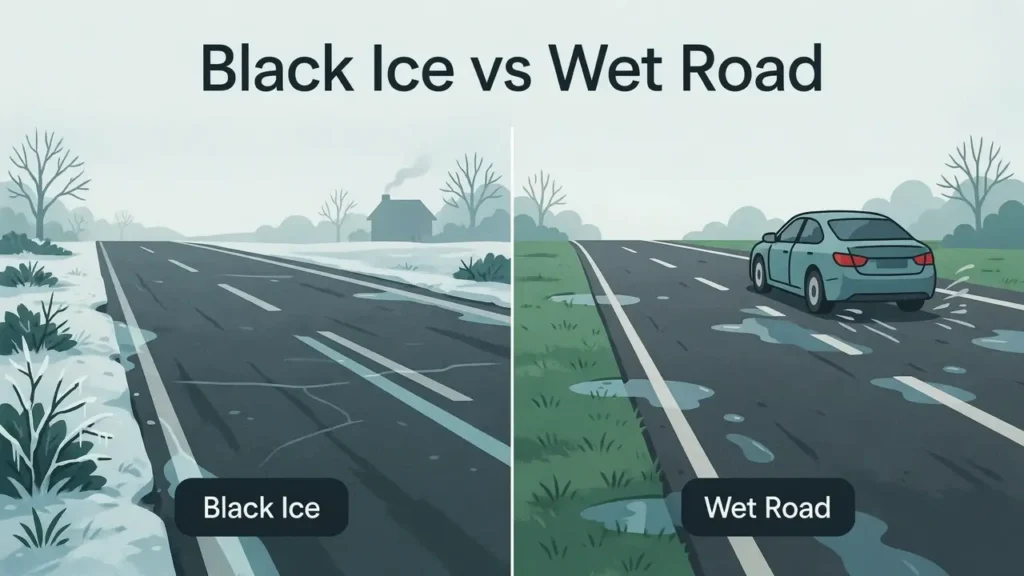
| Feature | Black Ice | Wet Road |
|---|---|---|
| Surface | Thin frozen layer | Liquid water |
| Appearance | Clear, dark or glossy | Dark and wet |
| Easy to see | Often difficult | Usually easier |
| Tire traction | Can be greatly reduced | Usually better than on ice |
| Tire spray | Usually little or none | May be visible |
| Main condition | Surface cold enough to freeze moisture | Water remains liquid |
Visual appearance alone is not a reliable test.
If freezing temperatures and moisture are present, use caution even if the pavement appears merely wet.
Black Ice vs Regular Ice
“Black ice” does not describe a special chemical type of ice.
It mainly describes thin, transparent road ice that is difficult to see.
Other ice may appear:
- White
- Cloudy
- Thick
- Rough
- Snow-covered
- Clearly visible
Black ice can be more deceptive because the pavement remains visible through it.
The hazard comes largely from its low visibility and slippery surface.
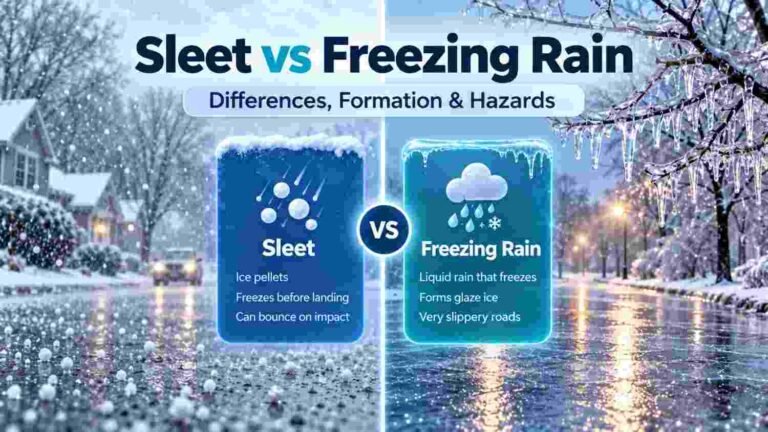
Black Ice vs Freezing Rain
Black ice and freezing rain are related but different.
Freezing Rain
Freezing rain is liquid precipitation that freezes when it contacts a sufficiently cold surface.
It can create glaze on:
- Roads
- Trees
- Vehicles
- Power lines
- Sidewalks
Black Ice
Black ice refers to a thin, transparent layer of ice on a road or other surface.
It may develop from freezing rain, but it can also form from:
- Rainwater refreezing
- Melted snow
- Fog
- Mist
- Other surface moisture
For a broader comparison involving winter precipitation, read our Freezing Rain vs Snow guide.
Can Black Ice Form Without Snow?
Yes.
Black ice does not require snowfall.
Rain can leave a roadway wet, and the remaining moisture can freeze later when pavement temperatures fall.
Fog, mist, freezing drizzle, and other moisture sources can also contribute.
This is especially important for families checking snow-day risk.
A forecast may show little or no snow while roads still develop dangerous ice.
Can Black Ice Form Without Rain?
Yes.
Rain is only one source of moisture.
Black ice may also develop from:
- Melting snow
- Freezing drizzle
- Fog
- Mist
- Condensation
- Water draining across pavement
The key combination is moisture plus a sufficiently cold surface.
Can Black Ice Form After Snow Stops?
Yes.
In fact, conditions after a snowstorm can be important.
Snow may melt during the day as temperatures rise or sunlight reaches the pavement.
That water can remain on the road.
If temperatures drop again after sunset, the water may refreeze.
This means a road that looked clearer in the afternoon can become icy again overnight.
Why Is Black Ice Dangerous?
The biggest problem with black ice is that drivers and pedestrians may not realize it is present.
Snow-covered roads provide an obvious visual warning.
Black ice may not.
A driver can move from dry or wet pavement onto ice with little warning.
That sudden change can reduce tire traction and affect:
- Braking
- Steering
- Acceleration
- Turning
- Hill climbing
- Vehicle stability
The risk can be greater on bridges, curves, hills, ramps, and untreated roads.
Why Black Ice Matters for School Buses
Black ice is particularly relevant to school transportation.
School buses may begin operating before sunrise, when overnight freezing conditions can still be present.
They also travel routes that often include:
- Residential streets
- Rural roads
- Hills
- Bridges
- Curves
- Shaded roads
- Smaller untreated streets
A major highway near a school might appear clear while portions of a bus route remain icy.
School buses also stop frequently and must repeatedly accelerate, brake, and turn.
For that reason, road conditions across the entire district may matter more than conditions directly outside the school building.
Can Black Ice Cause School Closures?
Yes.
Black ice can contribute to a school closure, delay, or transportation change when roads and walking surfaces become unsafe.
There is no universal amount of black ice that automatically closes every school.
District officials may consider:
- Bus-route conditions
- Bridges
- Rural roads
- Hills
- Parking areas
- Sidewalks
- Overnight temperatures
- Road-treatment progress
- Weather forecasts
- Whether conditions are improving
This also explains why a school can close or delay even when there is little fresh snow.
Ice can create a transportation problem without producing a large snowfall total.
For more context, read our guide explaining why ice can cause more school closures than snow.
Why Black Ice Can Be a Bigger Morning Problem Than Snow
Snow is usually visible.
Black ice often is not.
That difference matters during the early morning school commute.
A district may wake up to roads that appear mostly clear but have isolated icy areas on:
- Bridges
- Shaded roads
- Rural routes
- Parking lots
- Sidewalks
Another complication is that road conditions can vary significantly across a school district.
One part of town may have dry pavement while another remains icy.
That makes early morning road inspections important during freezing conditions.
Black Ice vs Snow-Covered Roads
| Condition | Black Ice | Snow-Covered Road |
|---|---|---|
| Appearance | Difficult to see | Usually obvious |
| Surface | Thin clear ice | Snow accumulation |
| Visibility problem | Mostly surface detection | Falling or blowing snow may reduce visibility |
| Traction | Can change suddenly | Usually reduced more visibly |
| Road clearing | Treatment may be needed | Plowing and treatment may be needed |
| School concern | Hidden icy sections | Accumulation, visibility and road access |
Both can affect school transportation, but they create different problems.
Black Ice vs Freezing Rain vs Snow
These terms describe different winter conditions.
| Condition | What It Means |
|---|---|
| Black ice | Thin clear ice already present on a surface |
| Freezing rain | Liquid precipitation that freezes on contact |
| Snow | Ice crystals or snowflakes falling from clouds |
Freezing rain can create black ice or other glaze.
Snow can melt and later refreeze into black ice.
Understanding these relationships is useful because road risk can continue after the active precipitation ends.
How to Check Black Ice Risk Before School
If temperatures are expected to fall near or below freezing before school, check the full weather picture.
Do not rely only on snowfall totals.
1. Check Overnight Temperatures
Look at the lowest temperature expected before sunrise.
2. Check Recent Precipitation
Ask whether roads may still be wet from:
- Rain
- Snowmelt
- Freezing drizzle
- Mixed precipitation
3. Check the Timing
Pay attention to conditions during the hours immediately before school buses begin operating.
4. Check Winter Weather Alerts
Local weather agencies may issue alerts when freezing conditions create travel concerns.
5. Check Road Conditions
State and local transportation agencies may provide road-condition information.
6. Check Your School District
The school district remains the official source for closure and delay decisions.
If freezing temperatures, snow, ice, or other winter hazards are expected, the Snow Day Predictor can provide an early estimate of how forecast conditions may affect the chance of a school closure.
If you already know the expected snow, ice, temperature, and wind conditions, use the Snow Day Calculator to test different winter-weather scenarios.
Both tools provide estimates, not official closure announcements.
Black Ice FAQs
Quick answers about what black ice is, how it forms, where it appears, and how it can affect winter roads and school travel.
What is black ice?
Black ice is a thin, clear or nearly transparent layer of ice on a road or another surface. The pavement underneath remains visible, which can make the ice difficult to see.
Is black ice actually black?
No. Black ice is usually clear or transparent. It appears dark because the pavement underneath shows through the thin layer of ice.
What causes black ice?
Black ice forms when moisture freezes on a sufficiently cold surface. The moisture can come from rain, melting snow, freezing drizzle, fog, mist, condensation, or water draining across pavement.
What does black ice look like?
Black ice can look like ordinary wet pavement. It may appear slightly glossy, dark, smooth, or reflective, but it can also be extremely difficult to identify visually.
What is black ice on the road?
Black ice on a road is a thin transparent layer of frozen water that allows the pavement underneath to remain visible. This can make the road look wet even when it is icy.
When is black ice most likely to occur?
Black ice is often a concern overnight and during early morning hours, especially after rain, melting snow, freezing drizzle, or a freeze-thaw cycle.
Where does black ice form first?
Bridges, overpasses, shaded roads, ramps, hills, low-lying areas, and untreated residential or rural roads can be higher-risk locations.
Why do bridges freeze before roads?
Bridges are exposed to cold air above and below, so their surfaces can cool differently from roads resting directly on the ground. This can allow ice to develop sooner on elevated surfaces.
Can black ice form without snow?
Yes. Rain, freezing drizzle, fog, mist, condensation, or other surface moisture can freeze on cold pavement even when no snow has fallen.
Can black ice form after snow melts?
Yes. Melted snow can leave water on pavement. If road temperatures fall below freezing later, that water can refreeze into a thin layer of ice.
Can black ice form when the air temperature is above freezing?
Road-surface temperature can differ from the reported air temperature. A sufficiently cold pavement surface can remain icy even when nearby air readings are slightly warmer.
Is black ice the same as freezing rain?
No. Freezing rain is liquid precipitation that freezes on contact with a cold surface. Black ice describes a thin, clear layer of ice already present on a road or another surface.
Is black ice more dangerous than snow?
Neither is always more dangerous. Black ice can be especially deceptive because it may be difficult to see, while heavy snow can reduce visibility, cover roads, and create drifting conditions.
Can black ice close schools?
Yes. Black ice can contribute to school closures or delayed openings when roads, bus routes, sidewalks, bridges, or parking areas become unsafe.
Can there be black ice with no snow on the road?
Yes. A road can appear completely free of snow while still having a transparent layer of ice on the pavement.
Why is black ice common in the morning?
Overnight cooling can cause moisture left from rain, melting snow, fog, or other sources to freeze before sunrise. That makes early morning a common time for hidden icy patches.
What Is Black Ice? The Bottom Line
Black ice is a thin, clear layer of ice that can be difficult to distinguish from the road beneath it. It commonly develops when moisture from rain, melting snow, freezing precipitation, fog, or other sources freezes on a cold surface.
The risk can be especially important overnight and during early morning hours.
Bridges, overpasses, shaded roads, hills, residential streets, and untreated routes deserve particular attention during freezing conditions.
For school-day planning, remember that dangerous winter roads do not always require heavy snowfall. A district can face icy bus routes even when roads appear mostly clear.
Check the local forecast, road conditions, winter weather alerts, and your school district’s official announcement.
For an early forecast-based estimate, use the Snow Day Predictor. To test specific snow, ice, temperature, and wind conditions, use the Snow Day Calculator.