Does It Snow in Nevada? Where, When and How Much Snow Falls
Yes, it snows in Nevada, and some parts of the state experience substantial winter snowfall. Although Nevada is famous for its deserts and the warm climate of Las Vegas, its northern cities, high valleys, and mountain ranges can have cold, snowy winters.
Reno receives regular winter snow, while communities such as Ely and Elko experience considerably more snowfall than Las Vegas. The Nevada side of Lake Tahoe, Mount Rose, Mount Charleston, and Great Basin National Park also have mountain environments where snow is an important part of winter.
The biggest factor is location. Nevada’s snowfall changes dramatically with elevation, so conditions in a desert valley can be completely different from those in nearby mountains.
Does It Snow in Nevada?
Yes. Snow falls across many parts of Nevada during winter.
However, Nevada does not have one uniform winter climate. The state includes low desert valleys, high-elevation cities, mountain ranges, and alpine environments.
Some locations receive little measurable snowfall during a typical year, while others experience repeated winter storms and maintain snow cover for months.
For example, the 1991 to 2020 normal annual snowfall is approximately:
- 0.2 inches in Las Vegas
- 14.0 inches in Carson City
- 20.9 inches in Reno
- 41.2 inches in Elko
- 54.1 inches in Ely
These are historical climate normals for selected locations, not snowfall totals for the entire state.
The differences explain why asking how much snow Nevada gets requires a more specific answer than one statewide figure.
Where Does It Snow in Nevada?
Snow occurs across Nevada, but it is most dependable in the mountains and colder northern and eastern areas.
The following table shows the broad regional pattern.
| Nevada Region | Typical Snowfall Pattern |
|---|---|
| Las Vegas Valley | Measurable snow is rare |
| Spring Mountains | Regular mountain snowfall |
| Reno | Regular winter snowfall |
| Carson City | Seasonal snow, generally less than nearby high mountains |
| Nevada side of Lake Tahoe | Snowy winters with substantial mountain snow |
| Northern Nevada | Cold winters and variable snowfall |
| Eastern Nevada | Snowy high valleys and mountain ranges |
| Great Basin National Park | Significant snow at higher elevations |
Northern Nevada
Northern Nevada includes Reno, Elko, Winnemucca, and numerous mountain ranges.
Winters are generally colder than in Southern Nevada, and snow is a normal part of the season.
However, Northern Nevada is not equally snowy everywhere.
A lower, relatively dry valley can receive far less snowfall than a nearby mountain range. Snow can also melt between storms in some communities while remaining on higher slopes.
Elko is a good example of a northern Nevada city with a notably snowy winter climate. Its 1991 to 2020 normal annual snowfall is approximately 41.2 inches.
Sierra Nevada and Lake Tahoe
The Sierra Nevada forms part of Nevada’s western mountain environment.
Lake Tahoe is shared by Nevada and California, so not every Lake Tahoe snowfall observation comes from Nevada.
On the Nevada side, areas around Incline Village, Mount Rose, and Stateline experience winter conditions influenced by the lake, surrounding terrain, and elevation.
The nearby Sierra Nevada mountains accumulate substantial snow, supporting skiing, snowboarding, snowshoeing, and other winter recreation.
Snowfall can differ sharply between lakeside communities, mountain passes, and higher ski areas.
A snow report from the top of a mountain should not be treated as the snowfall total for a town beside Lake Tahoe.
Central and Eastern Nevada
Central and Eastern Nevada contain high valleys, mountain basins, and rugged mountain ranges.
Cities such as Ely can experience long periods of cold weather and regular winter snowfall.
Ely’s 1991 to 2020 normal annual snowfall is approximately 54.1 inches, illustrating how snowy Nevada’s interior can be.
The mountains surrounding these communities can receive more snow than the cities themselves.
Southern Nevada
Southern Nevada is generally warmer and drier at lower elevations.
Las Vegas receives very little measurable snowfall in an average year, but that does not mean snow is absent from the region.
Nearby higher terrain, especially the Spring Mountains, can be snowy while the Las Vegas Strip remains dry.
This contrast is one of the most important things to understand about snowfall in Nevada.
When Does It Snow in Nevada?
Nevada’s main snowfall season generally falls between November and March, although the timing changes by region and elevation.
In cities such as Reno and Elko, winter snowfall is most common during December, January, and February.
In the higher mountains, snow can begin in fall and continue into spring.
Las Vegas is different. Its winter climate is generally too mild and dry for dependable city snowfall.
Does It Snow in Nevada in October?
Yes, particularly at higher elevations.
Early-season snowfall is possible in mountain areas and some colder northern or eastern locations.
However, October snow is not a normal expectation for the Las Vegas Valley.
Does It Snow in Nevada in November?
Yes.
November marks the beginning of more frequent winter conditions in many northern Nevada communities and mountain areas.
Reno’s 1991 to 2020 normal November snowfall is approximately 1.8 inches.
Does It Snow in Nevada in December?
Yes. December is one of Nevada’s main winter snowfall months.
Reno’s normal December snowfall is approximately 5.2 inches, while higher mountain areas can receive much more.
Measurable snowfall remains uncommon in Las Vegas.
Does It Snow in Nevada in January?
Yes.
January is a major snow month in Northern Nevada, the Sierra Nevada, and many high-elevation parts of the state.
Reno’s normal January snowfall is approximately 5.2 inches.
Does It Snow in Nevada in February?
Yes.
February remains part of the main snow season. Reno’s normal February snowfall is also approximately 5.2 inches.
Even Southern Nevada can occasionally experience an unusually cold storm during this period.
Does It Snow in Nevada in March?
Yes.
Snow remains possible in many Nevada cities during March, and mountain snowfall can continue well into spring.
Reno’s normal March snowfall is approximately 2.9 inches.
Can It Snow in Nevada in April or May?
Yes, especially in the mountains.
Late-season snow is possible around Lake Tahoe, Mount Rose, Great Basin National Park, and other high-elevation areas.
Lower-elevation Southern Nevada locations are much less likely to receive snow during these months.
How Much Snow Does Nevada Get?
Nevada snowfall varies too much for one statewide average to describe conditions accurately.
A city comparison is more useful.
| Nevada Location | Normal Annual Snowfall |
|---|---|
| Las Vegas | 0.2 inches |
| Carson City | 14.0 inches |
| Reno | 20.9 inches |
| Elko | 41.2 inches |
| Ely | 54.1 inches |
The figures are based on the 1991 to 2020 climate-normal period.
Actual snowfall varies from winter to winter, and totals can differ between neighborhoods, weather stations, and nearby mountain areas.
A long-term average also does not mean the same amount falls every year.
Does It Snow in Las Vegas, Nevada?
Yes, it can snow in Las Vegas, but measurable snowfall is rare in the lower Las Vegas Valley.
The city’s 1991 to 2020 normal annual snowfall is approximately 0.2 inches.
That does not mean snow falls every year or that each snowfall event produces only 0.2 inches. Climate normals average conditions over a long period.
Some winters produce no measurable snow at the official station, while an unusual cold storm can occasionally bring accumulation.
One notable example occurred in February 2019.
The National Weather Service documented accumulating snow across parts of the Las Vegas Valley during February 17 through February 21, 2019.
Snow amounts differed across the valley because of changing temperatures, elevation, and precipitation patterns.
Does It Snow on the Las Vegas Strip?
It is possible, but accumulating snow on the Strip is unusual.
Snow in the surrounding mountains is much more common than snowfall in the city’s main tourist areas.
Can You See Snow Near Las Vegas?
Yes.
The Spring Mountains and Mount Charleston area offer opportunities to see mountain snow without traveling to Northern Nevada.
Conditions and road access still depend on the weather.
Does It Snow in Reno, Nevada?
Yes. Reno receives regular winter snowfall.
NOAA’s 1991 to 2020 climate normals for Reno-Tahoe International Airport show approximately 20.9 inches of annual snowfall.
The normal monthly amounts are:
| Month | Normal Snowfall |
|---|---|
| October | 0.1 inch |
| November | 1.8 inches |
| December | 5.2 inches |
| January | 5.2 inches |
| February | 5.2 inches |
| March | 2.9 inches |
| April | 0.4 inches |
| May | 0.1 inch |
Monthly values are rounded.
Reno’s snowfall is concentrated in winter, but individual storms can bring significantly different amounts.
Some winters are relatively mild, while others include disruptive snow and icy roads.
Higher neighborhoods and nearby mountain areas may also receive more snow than the airport station.
Reno should not be confused with the much snowier high elevations around Lake Tahoe and Mount Rose.
Does It Snow in Carson City, Nevada?
Yes.
Carson City experiences seasonal winter snowfall.
Its 1991 to 2020 normal annual snowfall is approximately 14 inches.
The city’s location near the Sierra Nevada means local snow conditions can change with elevation.
Nearby mountain roads may experience deeper snow and more difficult travel conditions than lower parts of the city.
Does It Snow in Lake Tahoe, Nevada?
Yes.
The Nevada side of Lake Tahoe experiences snowy winters, and its surrounding mountains can accumulate substantial seasonal snow.
Important Nevada-side locations include:
- Incline Village
- Mount Rose
- Stateline
- The Nevada side of the Heavenly ski area
Snowfall varies between the shoreline and higher mountain terrain.
A lakeside town may have relatively light snowfall while nearby ski slopes receive a major storm.
Lake Tahoe is shared with California, so travelers should check the forecast and road conditions for the specific side of the lake they plan to visit.
Does It Snow at Mount Charleston?
Yes. Snowfall is a normal winter occurrence in the higher elevations of the Spring Mountains around Mount Charleston.
This is one reason residents and visitors can find snow near Las Vegas even when the city itself has mild weather.
The area includes Lee Canyon and designated winter recreation locations.
However, snow is not guaranteed on every winter day.
Mountain storms can also create traffic restrictions, limited parking, and temporary closures.
Before traveling from Las Vegas, check current weather, road access, and recreation-area notices.
Does It Snow in Ely and Elko?
Yes. Both cities have notably snowy winter climates.
Ely
Ely is located in Eastern Nevada and has a much colder winter environment than Las Vegas.
Its 1991 to 2020 normal annual snowfall is approximately 54.1 inches.
Snow can occur across a long winter season, and nearby higher terrain may retain snow into spring.
Elko
Elko is in Northeastern Nevada.
Its 1991 to 2020 normal annual snowfall is approximately 41.2 inches.
The surrounding Ruby Mountains and other higher terrain can experience deeper seasonal snow than the city.
These two communities demonstrate why Nevada should not be described simply as a warm desert state.
Does It Snow in Great Basin National Park?
Yes. Great Basin National Park has substantial winter snow at higher elevations.
The park’s elevation changes dramatically from lower desert environments to alpine terrain around Wheeler Peak.
According to the National Park Service, around 3 to 6 feet of snow can accumulate near Wheeler Peak Campground and the Alpine Lakes Loop Trail under typical winter conditions.
That does not mean snow is equally deep throughout the park.
Lower elevations may be relatively snow-free while the mountains remain deeply covered.
The National Park Service also closes the upper Wheeler Peak Scenic Drive to regular vehicle traffic during winter.
Visitors should not assume they can drive to the upper trailheads after a major snowfall.
Where Does Nevada Get the Most Snow?
Nevada’s higher mountain regions generally offer the most dependable winter snow.
Notable snowy environments include:
- Mount Rose and the Nevada side of the Sierra Nevada
- Ruby Mountains
- Spring Mountains around Mount Charleston
- Snake Range and Wheeler Peak
- Other high-elevation ranges in Northern and Central Nevada
The precise snowiest location can change depending on whether the comparison uses annual snowfall, maximum snow depth, or snow water equivalent.
These are different measurements.
For readers simply looking for winter scenery, the Sierra Nevada near Lake Tahoe and the Spring Mountains near Las Vegas are recognizable examples of Nevada’s mountain snow.
Why Does Snow Fall in a Desert State?
A desert is defined largely by limited precipitation, not by permanently warm temperatures.
Many Nevada valleys are dry, but they can still become cold enough for snow.
The state also contains numerous mountains where winter temperatures are considerably lower than in nearby valleys.
Several factors influence snowfall.
Elevation
Air temperatures generally decrease with elevation.
A storm that brings rain to Las Vegas may produce snow at Mount Charleston.
Winter Storms
Pacific storm systems can bring moisture into Nevada.
When enough moisture combines with cold air, snowfall becomes possible.
Mountain Terrain
Mountain slopes can lift incoming air, encouraging precipitation.
Higher terrain is also more likely to remain cold enough for snow.
Local Climate
Northern, eastern, and southern Nevada have different temperature and precipitation patterns.
That is why Reno, Ely, Elko, and Las Vegas have such different snowfall normals.
How Long Does Snow Stay on the Ground in Nevada?
Snow-cover duration varies by elevation, temperature, and exposure to sunshine.
In Las Vegas, rare snow accumulations often disappear relatively quickly once temperatures rise.
In Reno and other northern cities, snow can remain longer during cold periods, although melting can occur between storms.
High mountain snowpack can last for months.
Shaded slopes and higher elevations often retain snow longer than sunny, lower terrain.
Great Basin National Park is a good example. Snow and ice can keep the upper Wheeler Peak Scenic Drive closed through winter and into spring.
What Is Nevada Snowpack?
Snowpack is the accumulated snow remaining on the ground, especially in the mountains.
It is different from new snowfall.
Nevada’s mountain snowpack is important for water supplies because melting snow contributes water to rivers, reservoirs, and surrounding communities.
The USDA Natural Resources Conservation Service monitors snowpack in Nevada and the Eastern Sierra through snow surveys and automated SNOTEL stations.
What Is Snow Water Equivalent?
Snow water equivalent, or SWE, measures the amount of water contained in snow.
Two locations can have the same snow depth but different water content.
That is why snow water equivalent is useful for understanding potential water supply, not just winter recreation conditions.
Is There Snow in Nevada Right Now?
Current snow conditions depend on recent storms, elevation, and temperature.
This article explains typical snowfall patterns rather than reporting live snow depth.
For current conditions, use:
- National Weather Service forecasts
- NRCS Nevada Snow Survey
- Nevada 511 or NV Roads
- National Park Service alerts
- Official ski-area snow reports
If you are planning a winter trip, check the exact location rather than relying on a general statewide forecast.
Driving in Nevada Snow
Nevada winter roads can become hazardous quickly, especially around mountain passes and higher elevations.
The Nevada Department of Transportation warns drivers about:
- Snow-covered roads
- Black ice
- Reduced visibility
- Rapidly changing mountain weather
- Snow-removal equipment
- Possible road closures
Before traveling, check Nevada 511 or NV Roads for current conditions.
Drive more slowly in winter weather, leave additional stopping distance, and comply with posted chain or traction-device requirements.
Nevada and California have different chain rules, which matters when traveling around Lake Tahoe or crossing the state border.
Do not assume that having an all-wheel-drive vehicle removes every traction requirement.
Nevada Snow and School Closures
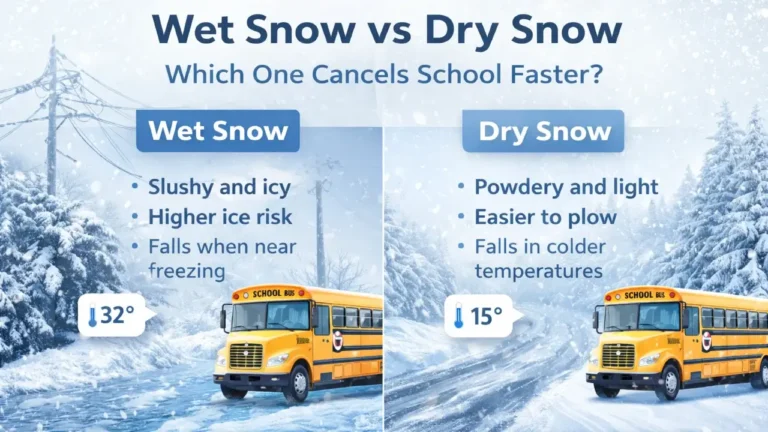
Snow can cause school delays and closures in Nevada, but snowfall amount is only one factor.
Schools may also consider:
- Ice on roads
- Bus route conditions
- Overnight temperatures
- Mountain travel
- Forecast storm timing
- Road-clearing operations
A snowfall event may have a different effect in Las Vegas than in Reno or a mountain community.
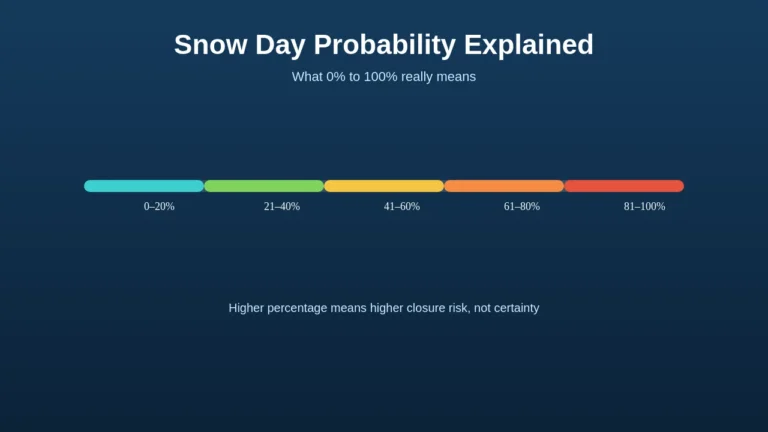
If winter weather could disrupt school schedules, the Snow Day Predictor can provide an estimate to consider alongside official weather forecasts.
School districts make the final decisions about closures and delays.
For more winter weather guides and tools, visit Snow Day Calculators.
Nevada Snow Facts at a Glance
| Question | Short Answer |
|---|---|
| Does Nevada get snow? | Yes |
| Does Las Vegas get snow? | Rarely at lower elevations |
| Las Vegas normal annual snowfall | About 0.2 inches |
| Does Reno get snow? | Yes, regularly in winter |
| Reno normal annual snowfall | About 20.9 inches |
| Does Carson City get snow? | Yes |
| Does Ely get snow? | Yes, with a normal of about 54.1 inches annually |
| Does Elko get snow? | Yes, with a normal of about 41.2 inches annually |
| Does Lake Tahoe’s Nevada side get snow? | Yes |
| Does Mount Charleston get snow? | Yes |
| Can Nevada mountains remain snowy into spring? | Yes |
| Does Nevada monitor mountain snowpack? | Yes, through NRCS |
FAQs About Snow in Nevada
Does Nevada get a lot of snow?
Some parts do. High mountain areas and colder northern and eastern communities can receive substantial snowfall, while Las Vegas and other low desert areas receive much less.
How often does it snow in Nevada?
There is no single statewide frequency. Snow is a regular winter event in many northern and high-elevation locations, but measurable snowfall is rare in Las Vegas.
When does snow start in Nevada?
Snow can begin in the mountains during fall. December through February are the core snowfall months for many lower-elevation northern communities.
Does Northern Nevada get snow?
Yes. Northern Nevada has cold winters, and snowfall is common in many cities and mountain areas.
Does Southern Nevada get snow?
Yes, especially in the Spring Mountains. Snow in the lower Las Vegas Valley is much less common.
Does it snow in Nevada in December?
Yes. December is a principal winter snowfall month in many parts of the state.
Does it snow in Nevada in March?
Yes. Snow remains possible in northern cities and is common in many mountain areas.
Can Nevada get snow in April?
Yes, especially in higher mountain environments.
Does Nevada City get snow?
Nevada City is located in California, not the state of Nevada. Its snowfall should be considered separately from this Nevada statewide guide.
Where can you see snow near Las Vegas?
The higher elevations of the Spring Mountains around Mount Charleston and Lee Canyon are commonly associated with winter snow.
Is Reno snowier than Las Vegas?
Yes. The cited 1991 to 2020 climate normals show approximately 20.9 inches of annual snowfall in Reno compared with 0.2 inches in Las Vegas.
Is the Sierra Nevada entirely in Nevada?
No. The Sierra Nevada mountain range lies primarily in California, with important mountain areas extending along Nevada’s western edge.
Understanding Nevada’s Snow Season
So, does it snow in Nevada? Yes, and in some areas snow is an essential part of winter.
Las Vegas usually remains relatively mild and receives very little measurable snowfall. Reno has a regular winter snow season, while Ely, Elko, Lake Tahoe’s Nevada side, and the state’s mountain ranges demonstrate how snowy Nevada can become.
For winter travel, the most useful question is not simply whether Nevada gets snow, but where you are going and how high that location is.
Check current forecasts, mountain conditions, and road restrictions before traveling. Historical averages explain what is typical, while the latest weather reports tell you what to expect during your visit.
Sources
- NOAA: U.S. Climate Normals, 1991 to 2020
- NOAA: Reno-Tahoe International Airport Climate Normals
- National Weather Service: Las Vegas Climate Normals
- National Weather Service: February 2019 Las Vegas Snow Events
- NRCS: Nevada Snow Survey
- NRCS: What Is a SNOTEL Station?
- National Park Service: Great Basin National Park in Winter
- National Park Service: Wheeler Peak in Winter
- Nevada Department of Transportation: Safe Winter Driving
- Nevada Department of Transportation: Traction and Chain Requirements