Does It Snow in Oregon? Where, When and How Much Snow Falls
Yes, it does snow in Oregon, but snowfall varies dramatically depending on where you are. Portland and the Willamette Valley receive occasional winter snow, while the Cascade Mountains can accumulate deep snow for months. Bend and parts of Central and Eastern Oregon also experience much more regular winter snowfall than the western lowlands.
Oregon’s coastline, valleys, mountains, and high desert have very different winter climates, so there is no single snowfall amount that represents the entire state.
If you are following winter weather and possible school disruptions, Snow Day Calculators also provides snow-related tools and guides.
Does It Snow in Oregon?
Yes. Snow falls across many parts of Oregon every winter.
However, where and how often it snows depends heavily on elevation and location.
The biggest differences are between:
- The Oregon Coast
- The Willamette Valley
- The Cascade Mountains
- Central Oregon
- Eastern Oregon
- Southern Oregon
At high elevations in the Cascades, deep seasonal snow is normal. Crater Lake National Park, for example, receives an average of about 41 feet of snow per year at park headquarters.
By comparison, Portland International Airport has a 1991 to 2020 normal annual snowfall of only 4.2 inches.
That contrast shows why talking about “average snowfall in Oregon” without naming a location can be misleading.
Where Does It Snow in Oregon?
Oregon’s most reliable snow is found at higher elevations, especially in the Cascade Range.
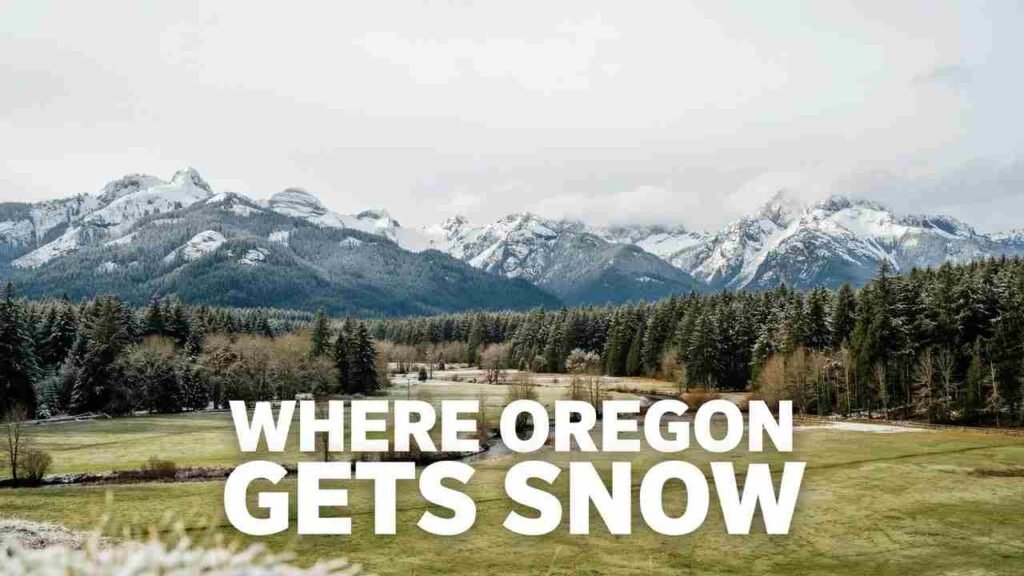
Snow also occurs regularly in Central and parts of Eastern Oregon, while lower western valleys and the coast see much less.
| Oregon Region | Typical Snow Pattern |
|---|---|
| Cascade Mountains | Heavy, dependable mountain snow |
| Central Oregon | Regular winter snowfall |
| Eastern Oregon | Colder winters with variable snow |
| Willamette Valley | Occasional lowland snow |
| Southern Oregon | Valley snow varies, mountains get much more |
| Oregon Coast | Snow is uncommon at sea level |
Cascade Mountains
The Cascade Range is Oregon’s main mountain snow zone.
Pacific storms bring moisture inland, and higher elevations are cold enough for much of that winter precipitation to fall as snow.
Important snowy areas include:
- Mount Hood
- Mount Jefferson area
- Santiam Pass
- Willamette Pass
- Mount Bachelor area
- Crater Lake National Park
Snow can begin in fall and remain well into spring at higher elevations.
Crater Lake gives a clear example of how different mountain Oregon is from the western lowlands. The National Park Service reports an annual average of roughly 41 feet, or 12.5 meters, of snowfall at park headquarters.
Snow is so persistent there that some park roads close for much of the winter and reopen in stages as snow conditions allow.
Central Oregon
Central Oregon has colder and snowier winters than much of the Willamette Valley.
Bend is the best-known example.
NOAA’s 1991 to 2020 climate normals for its Bend station show an average annual snowfall of approximately 21.6 inches. January averages about 6.4 inches, followed by February at 5.5 inches and December at 5.3 inches.
Nearby mountain areas can receive far more snow than Bend itself because elevation increases quickly toward the Cascades.
This means you can have relatively manageable conditions in town while significantly deeper snow exists in nearby mountain recreation areas.
Eastern Oregon
Eastern Oregon generally has a colder and more continental winter climate than Oregon’s western lowlands.
Snow varies widely because Eastern Oregon contains:
- High plateaus
- Mountain ranges
- Valleys
- Dry basins
- Lower-elevation communities
Some places get regular winter snow, while others remain relatively dry despite cold temperatures.
This is an important distinction. Colder does not automatically mean snowier. Enough moisture must also be available for significant snowfall.
Higher areas of northeastern and southeastern Oregon can hold snow considerably longer than lower valleys.
Willamette Valley
The Willamette Valley includes Portland, Salem, Eugene, Corvallis, and many surrounding communities.
Winter here is usually wetter than it is snowy.
Low elevations receive much of their winter precipitation as rain, but sufficiently cold storms can still produce snow, freezing rain, and ice.
Snow events can be especially disruptive because they are less routine than in mountain communities.
Southern Oregon
Southern Oregon has another large elevation contrast.
Cities such as Medford and Grants Pass may receive occasional winter snow, while nearby mountain terrain can experience far more severe conditions.
Ashland also sits close to higher terrain, including the Siskiyou Mountains.
Siskiyou Pass on Interstate 5 is particularly important for winter travelers. Oregon Department of Transportation guidance notes that severe winter restrictions and conditional chain requirements can occur there.
So “snow in Southern Oregon” can mean very different things depending on whether you are talking about a valley city or a mountain pass.
Oregon Coast
Yes, it can snow on the Oregon Coast, but sea-level snowfall is uncommon.
The Pacific Ocean moderates winter temperatures, which means coastal precipitation usually falls as rain.
Rare cold weather setups can still bring snow to coastal communities or nearby higher terrain.
So the Oregon Coast should not be described as a place that never gets snow, but travelers should not expect dependable winter snow there either.
When Does It Snow in Oregon?
There is no single snow season that applies to the entire state.
For Oregon’s western lowlands, including Portland and much of the Willamette Valley, snow is most likely during the heart of winter.
That generally means:
- December
- January
- February
Portland’s official 1991 to 2020 climate normals show most normal snowfall concentrated in those three months.
Mountain snow follows a much longer season.
High parts of the Cascades can receive snow in fall and continue seeing it well into spring. At Crater Lake, the National Park Service notes that even May, June, and October can alternate between sunny conditions and periods of rain or snow.
Central and Eastern Oregon can also see snow earlier in fall and later in spring than the western lowlands.
Does It Snow in Oregon in November?
Yes.
November snow is possible in many parts of Oregon and is increasingly likely at higher elevations.
Portland may receive only trace or occasional snow in November, while Cascade passes can already be experiencing full winter conditions.
Does It Snow in Oregon in December?
Yes. December is part of the main winter snow period across much of Oregon.
Mountain snow is common, and low-elevation cities can also experience snow when sufficiently cold weather arrives.
Does It Snow in Oregon in January?
Yes.
January is one of the most likely months for lowland snow and is firmly within the main mountain snow season.
Portland’s 1991 to 2020 normal snowfall for January is about 1.7 inches, the highest monthly normal at Portland International Airport.
Does It Snow in Oregon in February?
Yes.
February can still bring snow to cities and heavy snowfall to the mountains.
The exact pattern varies considerably from year to year.
Does It Snow in Oregon in April?
It can.
April snow is uncommon in most lowland western cities, but it remains possible. At higher elevations, April is still very much part of the snow season.
How Much Snow Does Oregon Get?
There is no useful single snowfall number for the entire state.
Oregon’s mountains receive dramatically more snow than its coastal and valley cities.
A better comparison is:
| Location | Typical Annual Snowfall Context |
|---|---|
| Portland International Airport | About 4.2 inches |
| Bend NOAA station | About 21.6 inches |
| Crater Lake National Park | About 41 feet |
| Oregon Coast | Usually little or no lasting sea-level snow |
| High Cascades | Heavy seasonal mountain snowfall |
Portland’s number comes from National Weather Service climate normals, Bend’s from NOAA climate normals, and Crater Lake’s from the National Park Service.
These figures should not be interpreted as guarantees for any particular winter.
Snowfall can vary greatly from year to year.
Does It Snow in Portland, Oregon?
Yes, Portland does get snow, but snowfall is relatively light and irregular compared with Oregon’s mountains.
The National Weather Service lists Portland International Airport’s 1991 to 2020 normal annual snowfall at 4.2 inches.
The monthly normals are:
- January: 1.7 inches
- February: 1.2 inches
- March: 0.1 inch
- November: trace
- December: 1.2 inches
However, those numbers do not mean Portland receives exactly that amount every year.
Some winters produce little measurable snow, while an individual storm can occasionally bring much more than the long-term normal.
Portland winter weather can also involve freezing rain and ice, which may create travel problems even when snowfall totals are not especially high.
Because Portland has a large dedicated keyword cluster, detailed Portland snowfall history, records, and month-by-month patterns are better covered in a separate Portland article rather than overloading this statewide guide.
Does It Snow in Bend, Oregon?
Yes. Snow is much more routine in Bend than in Portland.
NOAA’s 1991 to 2020 normals show approximately 21.6 inches of annual snowfall at the Bend station used for the dataset.
Snow normally falls primarily from late fall through early spring, with the largest average monthly totals occurring in winter.
Bend’s elevation and location east of the Cascades contribute to its colder winter climate.
The mountains west of Bend receive much deeper snow, so conditions around Mount Bachelor and the Cascade crest should not be assumed from conditions in downtown Bend.
Does It Snow in Salem and Eugene?
Yes, both Salem and Eugene can get snow.
They are part of the Willamette Valley, where winter rainfall is much more common than persistent snowfall.
Most winters have long periods without snow on the ground, but sufficiently cold Pacific storms can produce:
- Snow
- Freezing rain
- Sleet
- Ice
When lowland snow does occur, travel can become difficult quickly because western Oregon winter storms often affect a large network of roads at the same time.
Does It Snow in Corvallis?
Yes, Corvallis can receive snow during cold winter storms.
Like nearby Salem and Eugene, however, Corvallis sits in the Willamette Valley, where rain is more common during winter than snow.
Persistent seasonal snow cover is not typical.
Does It Snow in Medford, Oregon?
Yes.
Medford receives occasional winter snow, but conditions in the valley can be very different from those in nearby mountains.
Higher elevations around Southern Oregon are more likely to receive and retain snow.
Travelers heading south from Medford toward Ashland and Siskiyou Pass should therefore pay closer attention to elevation and highway conditions than city weather alone.
Does It Snow in Ashland, Oregon?
Yes.
Ashland can get winter snow, and nearby higher elevations can receive substantially more.
Its location near the Siskiyou Mountains makes winter driving conditions particularly important for travelers heading through Southern Oregon.
ODOT notes that conditional winter closures and chain restrictions are common on Interstate 5 around Siskiyou Pass south of Ashland during severe conditions.
Where Does Oregon Get the Most Snow?
Oregon’s heaviest and most dependable snowfall generally occurs at high elevations in the Cascade Mountains.
Crater Lake National Park is one of the strongest examples.
The National Park Service reports an average of approximately 41 feet of snow annually at park headquarters. Its records also show just how extreme individual winters can become.
Mount Hood and other high Cascade areas also accumulate substantial seasonal snow.
It is better to describe these as some of Oregon’s snowiest high-elevation environments rather than declare one permanent statewide “snowiest place” without defining a specific measurement and time period.
Annual snowfall, maximum snow depth, snowpack water content, and length of snow cover are different measures.
Why Does Snowfall Vary So Much Across Oregon?
Several geographic factors create Oregon’s dramatic snow differences.
Elevation
Elevation is one of the biggest factors.
Temperatures generally decrease as elevation rises, so precipitation that falls as rain in a valley may fall as snow on a nearby mountain.
Pacific Moisture
Oregon receives major winter weather systems from the Pacific Ocean.
When moist air reaches higher mountain terrain, it cools and can produce heavy precipitation.
Cascade Mountains
The Cascades strongly influence Oregon’s climate.
Western slopes receive large amounts of Pacific moisture, while areas east of the range are much drier.
Rain Shadow
Central and Eastern Oregon lie partly in the rain shadow of the Cascades.
These locations can be colder than western Oregon but often receive less precipitation overall.
Local Terrain
Mountain passes, valleys, basins, and slopes can experience different snow conditions even when they are relatively close together.
That is why checking the forecast for the exact location and elevation is important.
What Does Snow Level Mean in Oregon?
Oregon weather forecasts often mention the snow level.
The snow level is the approximate elevation above which precipitation is expected to fall mainly as snow rather than rain.
For example, a storm might bring rain to Portland while snow falls on Mount Hood because temperatures are colder at higher elevations.
Snow level is especially useful for:
- Cascade travel
- Mountain passes
- Ski areas
- Hiking
- Winter road planning
It changes from storm to storm, so there is no permanent Oregon snow level.
How Long Does Snow Stay on the Ground in Oregon?
Again, elevation matters.
In Portland, Salem, Eugene, and many other western lowland communities, snow may melt within hours or days after a storm if temperatures rise.
Central and Eastern Oregon can maintain snow cover longer during cold periods.
High Cascade locations can remain snow-covered for months.
Crater Lake receives enough snow that portions of the park’s road system typically remain seasonally closed for much of winter and spring.
So snowfall amount alone does not tell you how long an area will look snowy.
What Is Oregon Snowpack?
Snowpack is the accumulated snow that remains on the ground, particularly in mountain areas.
It is different from a single snowfall event.
Oregon’s mountain snowpack matters because it stores water through winter and contributes to streamflow as it melts in spring and summer.
The Natural Resources Conservation Service monitors Oregon snow using SNOTEL, SNOLITE, snow-course, and other monitoring sites. Its Oregon network includes dozens of automated stations that measure conditions such as snow depth and snow water equivalent.
Snow water equivalent, often shortened to SWE, estimates how much water is contained in the snowpack.
That can be more useful for water management than simply knowing how many inches of snow are on the ground.
Is There Snow in Oregon Right Now?
That depends on the date, elevation, and recent weather.
This evergreen guide should not be used as a live snow report.
For current conditions, check:
- National Weather Service forecasts
- NRCS Oregon Snow Survey
- Oregon TripCheck
- Individual mountain or ski-area condition reports
- National Park Service conditions for places such as Crater Lake
The NRCS Oregon Snow Survey provides current snow depth and snow water equivalent information by station and basin.
Current-snow queries such as snow in Oregon right now, Oregon snow forecast, and current snow level Oregon represent a separate freshness intent from the evergreen question of whether Oregon gets snow.
Driving in Oregon Snow
Winter driving conditions can change quickly in Oregon, particularly at mountain passes.
The Oregon Department of Transportation uses Snow Zone signs to tell motorists when chains or traction tires must be carried or used. TripCheck also displays current chain and traction-tire requirements.
ODOT recommends that winter drivers:
- Check TripCheck before leaving
- Carry chains and know how to install them
- Slow down on snow and ice
- Leave extra stopping distance
- Watch for ice on bridges and shaded areas
- Keep an emergency kit in the vehicle
ODOT specifically warns that ice can form even on low-elevation roads and that black ice can be difficult to see.
Do You Need Chains in Oregon?
It depends on current road restrictions and your vehicle.
Snow Zone signs show when chains or approved traction tires are required.
Some four-wheel-drive and all-wheel-drive vehicles may qualify for exemptions in typical winter conditions if they meet Oregon’s requirements, but severe conditions can trigger restrictions requiring chains more broadly.
Drivers should follow the posted requirement rather than assuming AWD is enough.
When Can You Use Studded Tires in Oregon?
ODOT says studded tires are legal in Oregon from November 1 through March 31.
The agency encourages motorists to consider chains or non-studded traction tires because studs damage pavement.
Oregon Snow and School Closures
Snow does not automatically close schools across Oregon.
A few inches of snow can have very different effects depending on the community.
Schools may consider:
- Road conditions
- Ice
- Elevation
- Bus routes
- Snow accumulation
- Forecast temperatures
- Freezing rain
- Timing of the storm
A mountain community accustomed to regular snow may operate normally under conditions that cause delays or closures in a lower-elevation city.
If an incoming storm may affect school schedules, you can check the Snow Day Predictor alongside National Weather Service forecasts and official school or district announcements.
The school district remains the source for the final closure or delay decision.
Oregon Snow Facts at a Glance
| Question | Short Answer |
|---|---|
| Does Oregon get snow? | Yes |
| Does Portland get snow? | Yes, but it is irregular |
| Portland normal annual snowfall | About 4.2 inches |
| Does Bend get snow? | Yes, regularly in winter |
| Bend normal annual snowfall | About 21.6 inches at the cited NOAA station |
| Does the Oregon Coast get snow? | Occasionally, but it is uncommon at sea level |
| Where is snow most dependable? | High Cascade Mountains |
| How much snow does Crater Lake get? | About 41 feet annually on average |
| When does lowland Oregon usually get snow? | Mainly December through February |
| Can Cascade snow continue into spring? | Yes |
| Does Oregon monitor mountain snowpack? | Yes, through NRCS snow monitoring networks |
FAQs About Snow in Oregon
Does Oregon get a lot of snow?
Some parts do.
High Cascade locations receive extremely heavy snowfall, while Portland, the Willamette Valley, and the coast receive much less.
How often does it snow in Oregon?
There is no statewide frequency. Mountain locations receive snow repeatedly through winter, while western lowlands may have only occasional snow events.
When does it start snowing in Oregon?
High mountain snow can begin in fall. Lowland cities are more likely to see snow from December through February.
Does it snow everywhere in Oregon?
Snow can occur across much of the state, but it is not equally common everywhere. Coastal and low-elevation western communities receive much less snow than mountain areas.
Does Portland get a lot of snow?
No, not compared with Oregon’s mountain regions. Portland International Airport’s 1991 to 2020 normal annual snowfall is about 4.2 inches.
Does Bend get more snow than Portland?
Yes, based on the cited official climate normals. The Bend station averages about 21.6 inches annually compared with about 4.2 inches at Portland International Airport.
Does it snow on the Oregon Coast?
Yes, but coastal snow at sea level is uncommon. Rain is much more typical during winter.
Does it snow in Southern Oregon?
Yes. Valley communities can receive occasional snow, while higher terrain and mountain passes can receive much more.
Does it snow in Oregon in December?
Yes. December is part of the primary winter snow season, particularly in the mountains.
Does Oregon have snow in April?
Yes, especially at higher elevations. Lowland April snow is much less common.
Where can you reliably find snow in Oregon?
The Cascade Mountains are generally the most dependable region for winter snow, including areas around Mount Hood, Mount Bachelor, and Crater Lake.
Is Oregon snowpack the same as snowfall?
No. Snowfall measures new snow that falls during a period. Snowpack refers to accumulated snow remaining on the ground.
Understanding Oregon’s Snow Season
So, does it snow in Oregon? Definitely, but Oregon does not have one uniform snow climate.
The Coast and western lowlands usually receive little snow, Portland gets occasional winter snowfall, Bend sees snow much more regularly, and the high Cascades can accumulate enormous seasonal snowpacks.
For planning a winter trip, elevation often matters as much as the city or region. Historical averages can tell you what is typical, but current conditions can be very different. Before heading into the mountains or across Oregon passes, check the latest National Weather Service forecast, NRCS snow data, and Oregon TripCheck road conditions.