Sleet vs Snow: How They Form, Look Different and Affect Winter Travel
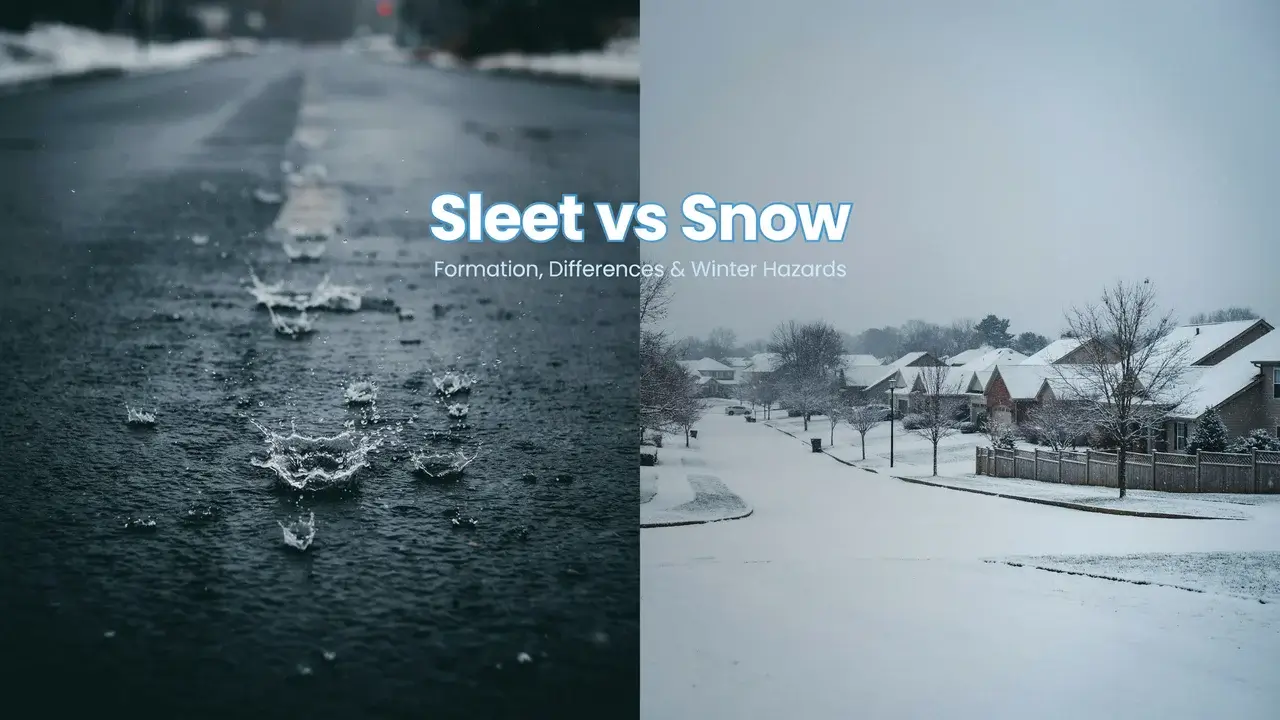
Sleet and snow are both frozen forms of precipitation, but they do not form or behave in the same way. Snow reaches the ground as ice crystals or snowflakes, while sleet falls as small, hard ice pellets that typically form after melted or partially melted snow refreezes before reaching the surface.
The difference matters during winter storms. Snow can accumulate on roads, reduce visibility, and create drifting conditions. Sleet can cover pavement with icy pellets that become slippery when they accumulate or are packed down by traffic.
When comparing sleet vs snow, the important differences are how they form, what they look like, how they accumulate, and how they affect roads and school transportation.
Sleet vs Snow: Quick Comparison
The easiest way to tell sleet and snow apart is to look at their shape and behavior when they reach the ground.
| Feature | Sleet | Snow |
|---|---|---|
| Form | Small ice pellets | Ice crystals or snowflakes |
| Formation | Melted or partially melted precipitation refreezes | Ice crystals grow in clouds |
| Appearance | Small, hard, often translucent pellets | Flakes or individual ice crystals |
| Sound | Often taps or rattles on hard surfaces | Usually falls more quietly |
| Behavior on impact | Often bounces | Usually settles on the surface |
| Accumulation | Granular layer of ice pellets | Snow cover or snowpack |
| Main road concern | Slippery pellets and compacted ice | Snow-covered roads and reduced traction |
| Visibility | Can decrease during heavy precipitation | Can decrease significantly during heavy or blowing snow |
| School closure concern | Icy roads and bus routes | Accumulation, visibility, drifting, and road clearing |
The main difference is that snow generally remains frozen as snowflakes while falling, whereas sleet undergoes melting followed by refreezing into ice pellets.
What Is Sleet?
Sleet is frozen precipitation that reaches the ground as small ice pellets.
According to the National Weather Service, sleet consists of frozen or mostly frozen raindrops or refrozen partially melted snowflakes.
The pellets often bounce when they strike pavement, rooftops, vehicles, or other hard surfaces.
You may recognize sleet by its tapping sound against a window or windshield.
Sleet can also collect on roads and sidewalks. When enough pellets accumulate, the surface can become slippery, particularly if the pellets are compressed by passing vehicles.
For a deeper explanation of sleet formation and characteristics, read our guide to What Is Sleet?.
What Is Snow?
Snow is frozen precipitation made of ice crystals that develop inside clouds.
The National Weather Service describes snow as precipitation consisting of ice crystals, commonly with branching hexagonal structures that may join together into snowflakes.
Snow crystals grow as water vapor deposits onto ice.
When the atmospheric conditions allow them to remain frozen during their journey toward the ground, they reach the surface as snow.
Depending on temperature, moisture, and other weather conditions, snowfall may consist of small crystals, large flakes, or combinations of different crystal shapes.
Once it reaches the ground, snow can accumulate on roads, sidewalks, rooftops, trees, and other surfaces.
How Does Sleet Form?
Sleet generally forms when frozen precipitation encounters different temperature layers while falling.
A typical sleet event involves three important atmospheric conditions:
- Cold air high in the atmosphere where frozen precipitation develops.
- A warmer layer that causes some or all of the falling snow to melt.
- A sufficiently deep layer of below-freezing air closer to the surface.
The final cold layer allows the melted or partially melted precipitation to refreeze before reaching the ground.
The result is small ice pellets rather than ordinary snowflakes.
Why the warm layer matters
Without a sufficiently warm layer, snowflakes can remain frozen as they fall.
When a warm layer causes melting, their structure changes.
If the resulting drops encounter deep enough freezing air below, they can turn into sleet before landing.
This explains why a winter storm can begin with snow and later change to sleet even if the temperature at ground level remains below freezing.
How Does Snow Form?
Snow begins inside clouds when ice crystals develop and grow.
Water vapor deposits onto ice crystals, allowing them to become larger. As they grow, crystals may develop different shapes depending on temperature and moisture conditions.
Some crystals join together to produce the larger snowflakes people commonly associate with snowfall.
For snow to reach the ground without melting completely, atmospheric conditions must allow the frozen precipitation to survive its journey toward the surface.
A completely below-freezing atmospheric column favors snow, although snow can sometimes reach the ground when surface air temperatures are slightly above 32°F.
The temperature through the atmosphere matters more than one thermometer reading.
Why Does It Sleet Instead of Snow?
The difference often depends on whether falling snow encounters a warm layer.
If the snow remains frozen, it can reach the ground as snowflakes.
If it melts partly or completely and then refreezes in colder air, sleet can form.
Meteorologists examine the temperature profile from the cloud toward the surface to determine which precipitation type is expected.
This is also why neighboring communities can experience different winter weather during the same storm.
One location may receive snow while another receives sleet because the depth and temperature of the atmospheric layers differ.
What Does Sleet Look Like Compared With Snow?
Sleet and snow are usually easy to distinguish when they fall separately.
What sleet looks like
Sleet typically appears as small, hard ice pellets.
You may notice:
- Pellets bouncing off pavement
- A tapping sound on windows
- Small translucent or whitish pieces of ice
- Granular accumulation on roads
- Pellets collecting along sidewalks
The individual pieces are generally more compact than snowflakes.
What snow looks like
Snow may fall as individual crystals or larger flakes.
Common signs include:
- Soft flakes drifting through the air
- Snow collecting on grass and rooftops
- White accumulation on roads
- Snowflakes resting on clothing
- Reduced visibility during heavier snowfall
Snow tends to create a more continuous covering, while sleet initially collects as separate ice pellets.
Does Sleet Bounce Like Snow?
Sleet commonly bounces when it strikes a hard surface.
The National Weather Service includes this behavior in its definition of sleet.
Snowflakes usually settle or break apart rather than bouncing like hard pellets.
Listening can also help.
Sleet may create a noticeable rattling or tapping sound against a car roof, window, or other hard surface.
Ordinary snowfall is usually much quieter.
Can Sleet Accumulate Like Snow?
Yes. Sleet can accumulate on the ground, although its texture differs from ordinary snow.
Accumulating sleet creates a granular layer of ice pellets.
Snow generally produces a layer of flakes or ice crystals that may later settle, compact, melt, or refreeze.
Sleet can become harder when traffic compresses the pellets or when other precipitation freezes around them.
The resulting surface can be difficult to walk or drive on.
Does sleet melt faster than snow?
There is no universal answer.
The melting rate depends on temperature, sunlight, wind, moisture, the amount of precipitation, and the structure of the accumulated material.
Loose snow and compacted sleet may melt at different rates under the same general weather conditions.
It is more useful to check the actual ground and pavement conditions than to assume one precipitation type will always disappear first.
Sleet vs Snow: Which Is More Dangerous?
Both sleet and snow can create dangerous winter travel conditions, but their hazards are different.
Sleet can make pavement slippery when ice pellets accumulate or become compacted.
Snow can reduce traction, cover road markings, limit visibility, and create drifting conditions.
The severity depends on the amount and intensity of precipitation, road treatment, temperature, wind, and storm timing.
A prolonged heavy snowfall may be more disruptive than a short period of light sleet.
Accumulating sleet can also create serious travel problems even when the forecast shows relatively little snow.
Neither precipitation type should be judged from its name alone. Actual road and weather conditions determine the risk.
Sleet vs Snow on Roads
Road conditions are one of the biggest practical differences between sleet and snow.
How sleet affects roads
Sleet reaches pavement as small ice pellets.
The pellets can collect on the surface, become packed beneath tires, and reduce traction.
Driving may become difficult on untreated roads, hills, bridges, and residential streets.
The hazard can increase when sleet mixes with snow or freezing rain.
How snow affects roads
Snow can create several problems at once.
It may:
- Cover lane markings
- Reduce tire traction
- Lower visibility
- Accumulate faster than plows can clear it
- Drift across previously cleared roads
- Make smaller streets difficult to navigate
Heavy snow can also affect emergency vehicles and school bus transportation.
Which is easier to remove?
Loose snow can often be pushed aside using snowplows.
Accumulated sleet may be harder to remove after ice pellets become compacted or freeze into a harder layer.
However, removal difficulty depends on the pavement temperature, precipitation amount, treatment, and condition of the accumulated material.
Why Sleet Can Be Dangerous Even With Little Snow
A forecast showing little snowfall does not necessarily mean the roads will remain clear.
Some storms produce sleet instead of snow.
The expected snow total may therefore be low while ice pellets continue accumulating on pavement.
This can create slippery conditions on:
- Residential roads
- School bus routes
- Bridges
- Parking lots
- Sidewalks
- Hills and intersections
Families checking for possible school closures should pay attention to the complete precipitation forecast rather than the snowfall total alone.
Sleet vs Snow for School Closures
Both sleet and snow can contribute to school closures or delayed openings.
The precipitation type is important, but it is not the only factor school officials may consider.
Other considerations include road conditions, storm timing, visibility, temperature, bus routes, and the availability of road-clearing equipment.
Can sleet close schools?
Yes.
Accumulating sleet can create slippery roads and difficult transportation conditions.
A district may consider delaying or canceling classes if buses and other vehicles cannot travel safely.
Sleet falling just before the morning commute may create more disruption than the same precipitation falling much earlier.
Can snow close schools?
Yes.
Snow can cause closures when accumulation, visibility, drifting, or road conditions make transportation difficult.
A heavy snowfall during the early morning hours can create problems even if road crews have already begun clearing major routes.
Is sleet more likely to close school than snow?
There is no universal rule.
The impact depends on storm intensity, precipitation amount, local road conditions, timing, and school transportation requirements.
A school district accustomed to heavy snow may have equipment and procedures that differ from those in an area where winter storms are less common.
The same weather system can therefore produce different school decisions in neighboring districts.
If sleet or snow is expected in your area, use the Snow Day Predictor to get an early estimate of tomorrow’s school closure chance based on forecast weather conditions.
Your school district remains the official source for closures and delays.
Why Storm Timing Matters for Sleet and Snow
The timing of precipitation can have a major influence on its impact.
Consider two winter storms producing similar amounts of snow.
The first ends around midnight, leaving several hours for road crews to clear important routes before school transportation begins.
The second starts shortly before sunrise and continues through the morning commute.
The second storm may create more transportation disruption because roads can deteriorate while buses and commuters are traveling.
Sleet creates a similar problem.
Ice pellets accumulating immediately before school transportation begins can make untreated roads difficult to use.
That is why the expected start time, duration, and end time of precipitation should be considered alongside accumulation.
Sleet vs Snow vs Freezing Rain
Sleet, snow, and freezing rain are three different forms of winter precipitation.
| Type | What reaches the ground | Main difference |
|---|---|---|
| Snow | Ice crystals or snowflakes | Remains frozen while falling |
| Sleet | Small ice pellets | Refreezes before landing |
| Freezing rain | Supercooled liquid droplets | Freezes after contacting a cold surface |
Freezing rain can create glaze ice on roads, sidewalks, vehicles, trees, and power lines.
Sleet reaches the ground already frozen.
Snow typically accumulates as flakes or ice crystals.
If you want to understand the difference between sleet and glaze ice in more detail, read our Sleet vs Freezing Rain guide.
You can also compare the effects of snow and freezing rain in our Freezing Rain vs Snow article.
Can Sleet and Snow Fall at the Same Time?
Yes.
Sleet and snow can occur together during mixed winter precipitation.
This may happen when atmospheric conditions are close to the boundary between those that support snow and those that produce sleet.
The precipitation can also change during a storm.
For example, a location might experience:
Snow → Sleet → Snow
Another storm may change from snow to sleet and then freezing rain as warmer air moves into different atmospheric layers.
These transitions can make winter travel conditions more complicated.
What Does a Forecast Mean When It Says Sleet or Snow?
A forecast mentioning sleet or snow is describing the expected precipitation type.
When checking the forecast, look beyond the name alone.
Important details include:
| Forecast detail | Why it matters |
|---|---|
| Precipitation type | Identifies the expected winter hazard |
| Start time | Shows when roads may begin deteriorating |
| Duration | Helps estimate how long conditions may remain difficult |
| Accumulation | Indicates how much precipitation may collect |
| Temperature | Helps assess melting and refreezing |
| Wind | Can worsen visibility and cause drifting snow |
| Weather alerts | Provide official information about expected hazards |
A wintry mix forecast may include several precipitation types.
For local U.S. forecasts and winter weather alerts, check the National Weather Service.
How to Check Your Snow Day Risk When Sleet or Snow Is Forecast
If winter precipitation is expected before school, start with your local forecast.
Pay particular attention to conditions during the hours when school buses and families begin traveling.
Check:
- Whether sleet or snow is expected.
- How much precipitation may accumulate.
- When the storm is expected to begin and end.
- Whether freezing rain is also possible.
- Whether roads are likely to remain below freezing.
- Whether local weather alerts are active.
- Whether your school district has announced a delay or closure.
If you want to compare different weather scenarios, use the Snow Day Calculator to estimate how changes in weather conditions may affect the chance of a school closure.
A calculator provides an estimate, not an official school announcement.
Frequently Asked Questions About Sleet vs Snow
What is the main difference between sleet and snow?
Snow reaches the ground as ice crystals or snowflakes. Sleet reaches the ground as small ice pellets that typically form when melted or partially melted snow refreezes before landing.
Is sleet the same as snow?
No. Both are frozen precipitation, but sleet consists of hard ice pellets while snow consists of ice crystals or snowflakes.
Is sleet frozen rain or frozen snow?
Sleet commonly forms when snow melts partly or completely in warmer air and then refreezes before reaching the ground. It can therefore be described as refrozen precipitation.
What does sleet look like compared to snow?
Sleet looks like small, hard pellets that often bounce on impact. Snow typically falls as softer flakes or individual ice crystals.
Is sleet worse than snow?
Neither is always worse. Accumulating sleet can create slippery roads, while heavy snow can reduce visibility, cover roads, and cause drifting. The impact depends on the storm.
Does sleet bounce?
Yes. Sleet commonly bounces when it hits pavement, vehicles, roofs, or other hard surfaces.
Does sleet stick to the ground?
Sleet can accumulate on the ground as ice pellets. It usually does not bond smoothly to the surface in the same way freezing rain does.
Can sleet accumulate like snow?
Yes. Sleet can build up on roads, lawns, sidewalks, and other surfaces, although it forms a different type of accumulation from ordinary snow.
Is sleet more dangerous to drive in than snow?
Both can create hazardous conditions. Sleet can reduce traction through accumulated ice pellets, while snow can reduce traction and visibility and create drifting conditions.
Can sleet close schools?
Yes. Sleet can contribute to school delays or closures when road, bus-route, or walking conditions become unsafe.
Can snow close schools without sleet?
Yes. Heavy snowfall, poor visibility, drifting snow, and difficult road conditions can cause closures without any sleet.
Can sleet and snow happen together?
Yes. Snow and sleet can fall together or occur at different times during the same winter storm.
At what temperature does sleet form instead of snow?
There is no single surface temperature that determines whether sleet or snow falls. The temperature profile through the atmosphere, including any warm layer and the depth of cold air below it, determines the precipitation type.
Is sleet the same as freezing rain?
No. Sleet freezes before reaching the ground. Freezing rain reaches the surface as liquid water and freezes after contact with a sufficiently cold surface.
Sleet vs Snow: The Bottom Line
The key difference between sleet vs snow is how the frozen precipitation forms and reaches the ground.
Snow consists of ice crystals or snowflakes that remain frozen as they fall.
Sleet consists of small ice pellets that typically develop after snow melts partly or completely and then refreezes before landing.
Both can affect roads, walking conditions, and school transportation.
Sleet may create slippery granular ice on pavement, while snow can accumulate, reduce visibility, and make road clearing difficult.
When winter weather is expected before school, check the precipitation type, accumulation, temperature, storm timing, road conditions, and official school announcements.
For an early forecast-based estimate, use the Snow Day Predictor. To compare different winter weather scenarios, try the Snow Day Calculator.
Always rely on your school district for the official closure or delay decision.