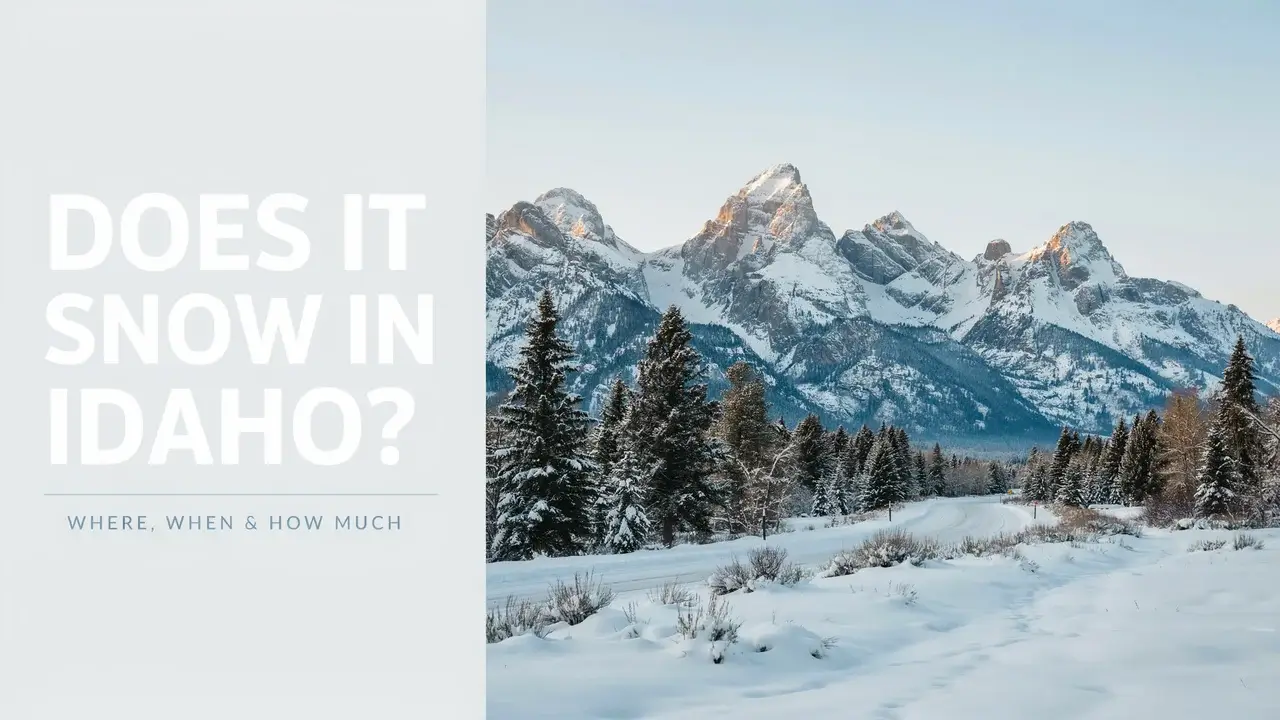
Does It Snow in Idaho? Where, When and How Much Snow Falls
Yes, it snows in Idaho every winter, and some parts of the state receive substantial snowfall. However, snow conditions vary considerably between Boise, the mountains of Central Idaho, the northern panhandle, and the high valleys of Eastern Idaho.
Boise gets regular winter snow but usually much less than nearby mountain communities. Places such as McCall, Island Park, and the higher elevations around the Sawtooth Mountains can experience deeper snow and a longer winter season.
If you are wondering whether Idaho gets snow, when it starts, or where to find it, the most important things to understand are elevation, location, and seasonal weather patterns.
Does It Snow in Idaho?
Yes. Snow is a normal part of Idaho’s winter climate.
Unlike states where snowfall is limited to a handful of high mountain summits, Idaho has many cities, valleys, and mountain communities that receive measurable winter snow.
But Idaho is not equally snowy everywhere.
The state includes:
- Low-elevation valleys
- High desert plains
- Mountain basins
- Forested mountain ranges
- Northern lake communities
- High-elevation recreation areas
A winter storm may bring light snow to Boise while dropping much larger amounts in the nearby mountains.
The difference is especially important when planning a winter trip or deciding whether a forecast for one Idaho city applies to another.
Where Does It Snow in Idaho?
Snow falls across Idaho, but the amount and duration depend strongly on elevation and regional climate.
| Idaho Region | Typical Winter Snow Pattern |
|---|---|
| Boise and Treasure Valley | Regular winter snow, but less than nearby mountains |
| Northern Idaho | Snowy winters, with heavier amounts in surrounding mountains |
| Central Idaho Mountains | Deep seasonal mountain snow |
| McCall and surrounding high country | Dependable winter snow |
| Eastern Idaho | Cold winters with regular snowfall |
| Island Park | Long, cold, snowy winter season |
| Snake River Plain | Snow varies by location and storm pattern |
Northern Idaho
Northern Idaho includes places such as Coeur d’Alene, Sandpoint, and the surrounding mountains.
The region experiences cold winters and regular snowfall. Mountain areas can accumulate deep seasonal snow, while conditions in towns and lakeside communities vary with elevation and local weather.
Snowfall is especially important for winter recreation in the mountains near Sandpoint and farther east toward the Montana border.
Northern Idaho should not be treated as having the same climate as Boise. The two regions differ in elevation, temperature, precipitation, and winter storm patterns.
Central Idaho Mountains
Central Idaho is home to some of the state’s most recognizable snowy landscapes.
The region includes:
- Sawtooth Mountains
- Salmon River Mountains
- Mountains around McCall
- Higher terrain near Stanley
- Sun Valley’s surrounding mountains
At high elevations, snowfall can begin in fall and continue well into spring.
Snow may remain on the ground for months, particularly in shaded forests and mountain basins.
This is a major reason Idaho is known for winter recreation, including skiing, snowshoeing, and snowmobiling.
Southern Idaho
Southern Idaho includes Boise and much of the Snake River Plain.
Winters can be cold enough for snow, but some valleys are relatively dry and receive less snowfall than the mountain areas around them.
The National Weather Service explains that Boise’s location in the Treasure Valley creates a comparatively mild winter climate. Some storms bring rain to the valley while higher elevations receive snow.
This is why snowfall conditions in Southern Idaho should be checked for the exact destination rather than the region as a whole.
Eastern Idaho
Eastern Idaho includes Idaho Falls, Pocatello, and areas near the Wyoming and Montana borders.
The region has cold winters, and snow is a normal seasonal occurrence.
However, snowfall differs between the Snake River Plain, higher valleys, and mountain terrain.
Eastern Idaho’s high-elevation communities can experience winter conditions for longer than lower and milder parts of Southwestern Idaho.
When Does It Snow in Idaho?
Idaho’s main winter snowfall period generally runs from November through March, although the season varies by location.
In the highest mountains, snow can arrive earlier and continue later.
For Boise and other lower-elevation cities, December, January, and February are usually the core winter snowfall months.
There is no guaranteed statewide date for the first snow.
A mountain pass may already have snow while a nearby valley remains dry.
Does It Snow in Idaho in October?
Yes, especially in the mountains and higher valleys.
October snowfall is possible in some lower-elevation locations, but it is much less dependable than winter snowfall.
Does It Snow in Idaho in November?
Yes.
November marks the beginning of more regular snowfall in many Idaho communities, and higher-elevation areas may already be developing a seasonal snowpack.
Does It Snow in Idaho in December?
Yes. December is one of the principal snowfall months.
According to NOAA’s 1991 to 2020 climate normals, Boise Air Terminal averages about 5.6 inches of snow in December, its highest monthly normal.
Mountain communities may receive substantially more.
Does It Snow in Idaho in January?
Yes.
January is firmly within Idaho’s winter snow season. Boise’s normal January snowfall is approximately 5.3 inches, while mountain locations can have deep accumulated snow.
Does It Snow in Idaho in February?
Yes.
February can bring additional snow to Idaho cities, valleys, and mountains.
Conditions vary by year, and snow already on the ground may remain even during periods without new snowfall.
Does It Snow in Idaho in March?
Yes.
March snowfall remains possible across Idaho. NOAA’s Boise normals include about 1.2 inches of March snowfall, while mountain regions can continue receiving substantial snow.
Can It Snow in Idaho in April or May?
Yes, particularly at higher elevations.
Spring snow is less typical in Boise than in the mountains, but late-season cold storms can still occur.
In high mountain areas, the winter snowpack may remain long after snowfall has become unusual in nearby valleys.
How Much Snow Does Idaho Get?
There is no single snowfall figure that accurately describes all of Idaho.
Annual snowfall changes considerably between a city in a lower valley and a nearby mountain.
For example, NOAA’s 1991 to 2020 normal annual snowfall for Boise Air Terminal is 17.6 inches.
That is a station-specific climate normal, not a statewide average.
| Location or Region | Snowfall Context |
|---|---|
| Boise Air Terminal | 17.6 inches annually, 1991 to 2020 normal |
| Boise Foothills | Conditions can be snowier than lower parts of the city |
| McCall | Snowy mountain-town environment |
| Island Park | Long winter season and substantial seasonal snow |
| High Central Idaho Mountains | Deep mountain snowpack |
| Northern Idaho Mountains | Heavy seasonal snow in many high-elevation areas |
Actual snowfall can differ greatly from one winter to another.
A long-term normal describes typical historical conditions over a defined period. It does not guarantee that the same amount will fall every year.
Does It Snow in Boise, Idaho?
Yes, Boise gets snow every winter season in the long-term climate record, although individual winters can be much snowier or less snowy than normal.
The official NOAA 1991 to 2020 climate normal for Boise Air Terminal is 17.6 inches of snow per year.
Its monthly snowfall normals are:
| Month | Normal Snowfall |
|---|---|
| October | 0.1 inch |
| November | 2.0 inches |
| December | 5.6 inches |
| January | 5.3 inches |
| February | 3.3 inches |
| March | 1.2 inches |
| April | 0.1 inch |
The monthly values are rounded, so adding them may differ slightly from the published annual normal.
Boise’s snowfall is not evenly distributed through winter. Some storms bring measurable snow, while others bring rain or a mixture of rain and snow.
Nearby foothills and mountains may also be snow-covered when lower parts of Boise are not.
Does It Snow in Idaho Falls?
Yes. Snow is a normal part of winter in Idaho Falls.
Idaho Falls lies in Eastern Idaho, where winters are colder than in many lower-elevation areas of the Treasure Valley.
The city can experience snow, icy roads, and extended periods of freezing temperatures.
However, Idaho Falls should not be confused with Island Park or the higher mountains farther northeast. Those locations have different elevations and snowfall patterns.
Does It Snow in Pocatello?
Yes.
Pocatello experiences winter snowfall, although the amount varies by storm and season.
The city sits in Southeastern Idaho near surrounding hills and mountains, so conditions can change considerably with elevation.
Travelers heading into nearby higher terrain may encounter deeper snow than they see in town.
Does It Snow in McCall, Idaho?
Yes. McCall is one of Idaho’s well-known winter mountain communities.
Located near Payette Lake, McCall sits at a higher elevation than Boise and has a snowier winter environment.
The surrounding area supports skiing, snowmobiling, and other winter recreation.
Idaho Parks and Recreation identifies December through April as the prime snowmobiling season for the McCall area, although actual snow and trail conditions vary.
McCall is a useful example of why a visitor cannot judge Idaho’s mountain weather from Boise’s forecast.
Does It Snow in Island Park, Idaho?
Yes. Island Park is known for long, cold winters and substantial seasonal snow.
Its location in Eastern Idaho near Yellowstone and high-elevation terrain makes it much snowier than many lower valleys.
Snowmobiling and other winter activities are common in the surrounding area.
However, a live Island Park snow-depth figure changes throughout the winter. It should not be confused with an annual snowfall average.
Anyone planning a trip should check the latest local forecast and snow observations.
Where Does Idaho Get the Most Snow?
Some of Idaho’s snowiest environments are found in the higher mountains of Northern and Central Idaho.
These include mountain areas around:
- McCall and Brundage Mountain
- Lookout Pass
- Schweitzer
- The Sawtooth Mountains
- Sun Valley
- The Clearwater Mountains
The exact location with the highest snowfall depends on the year, station, elevation, and measurement method.
For that reason, it is better to identify these as major mountain snow areas than declare a permanent statewide snowfall winner without a defined data comparison.
Why Does Idaho Get So Much Snow in Some Areas?
Idaho’s mountain geography is one of the main reasons snowfall varies so much across the state.
Elevation
Higher elevations are generally colder than lower valleys.
A storm that produces rain in Boise may bring snow to nearby mountain roads and ski areas.
Mountain Terrain
Mountains can force moist air upward. As the air rises and cools, it can produce precipitation, including snow when temperatures are sufficiently low.
Winter Storm Tracks
Pacific weather systems can bring moisture into Idaho during the colder months.
The effects differ between Northern Idaho, Central Idaho, and the drier southern valleys.
Valley Temperatures
Lower valleys do not always stay cold enough for snow.
The National Weather Service notes that Boise’s Treasure Valley location can result in rain rather than snow during some winter precipitation events.
Local Weather Patterns
Wind, temperature inversions, and the orientation of individual mountain ranges can produce different conditions over relatively short distances.
This is why a forecast for Boise should not be used as a forecast for McCall, Island Park, or a mountain pass.
How Long Does Snow Stay on the Ground in Idaho?
That depends on temperature, elevation, sunshine, and the amount of snow that falls.
In lower areas of Boise, snow can melt between storms when temperatures rise.
In colder Eastern Idaho communities, snow may remain longer during sustained freezing weather.
High mountain areas can maintain snow cover for months.
Snowfall and snow cover are not the same thing. A location may receive frequent snow without maintaining a deep snowpack all winter if melting occurs between storms.
What Is Idaho Snowpack?
Snowpack refers to accumulated snow remaining on the ground, especially in mountain areas.
It matters for more than winter recreation.
As snow melts in spring and summer, it contributes water to Idaho’s rivers, reservoirs, and other water supplies.
The USDA Natural Resources Conservation Service monitors Idaho’s mountain snowpack through snow courses and automated SNOTEL stations.
SNOTEL stands for Snow Telemetry.
These stations help measure important conditions such as snow depth, precipitation, and snow water equivalent.
What Is Snow Water Equivalent?
Snow water equivalent, or SWE, estimates the amount of water contained in the snowpack.
For example, two locations with the same snow depth may contain different amounts of water if one has light, dry snow and the other has denser snow.
This makes SWE especially useful for understanding water supply conditions.
Is It Snowing in Idaho Right Now?
That depends on the location and current weather.
This article explains Idaho’s typical snow climate, not live snowfall conditions.
For current snow information, check:
- National Weather Service forecasts
- NRCS Idaho Snow Survey
- Idaho 511 road conditions
- Official ski-area snow reports
- Local weather alerts
The NRCS Idaho Snow Survey publishes current snow-depth and snow-water-equivalent maps.
For mountain travel, check both the forecast and road conditions before leaving.
Where Can You See Snow in Idaho?
Visitors looking for dependable winter snow should generally consider higher-elevation destinations rather than relying on snowfall in Boise.
Places commonly associated with winter snow include:
| Destination | What to Expect |
|---|---|
| McCall | Snowy mountain-town setting |
| Brundage Mountain area | Winter mountain snow and skiing |
| Sun Valley area | Snowy mountain recreation |
| Schweitzer area | Northern Idaho mountain snow |
| Lookout Pass area | Mountain snowfall near the Montana border |
| Island Park | Cold winter conditions and snow recreation |
| Sawtooth Mountains | High-elevation mountain snow |
Snow availability depends on the date and weather, and access may be restricted during storms.
Before traveling, confirm whether roads, recreation areas, and facilities are open.
Driving in Idaho Snow
Winter driving in Idaho can be challenging, particularly in mountains and on high-elevation highways.
A route that is clear in a valley may become snow-covered farther uphill.
Before a winter trip:
- Check the latest National Weather Service forecast.
- Review Idaho 511 for road conditions and closures.
- Check conditions at mountain passes.
- Carry appropriate winter equipment.
- Allow extra travel time.
- Avoid assuming that all-wheel drive prevents skidding on ice.
The official Idaho 511 system provides road-condition information, closures, cameras, and other travel updates.
Idaho Snow and School Closures
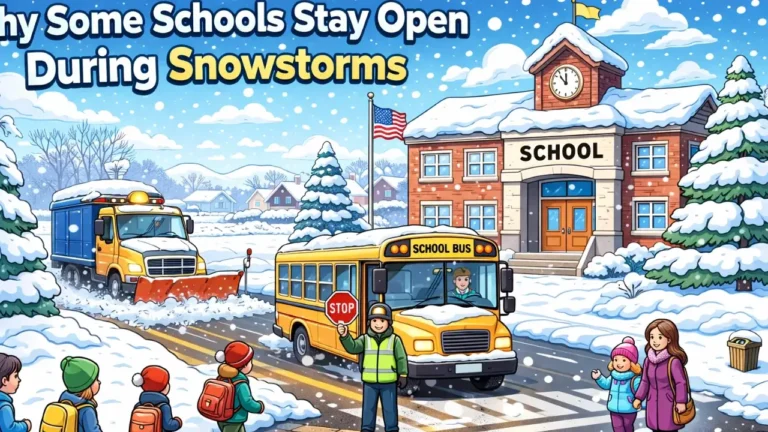
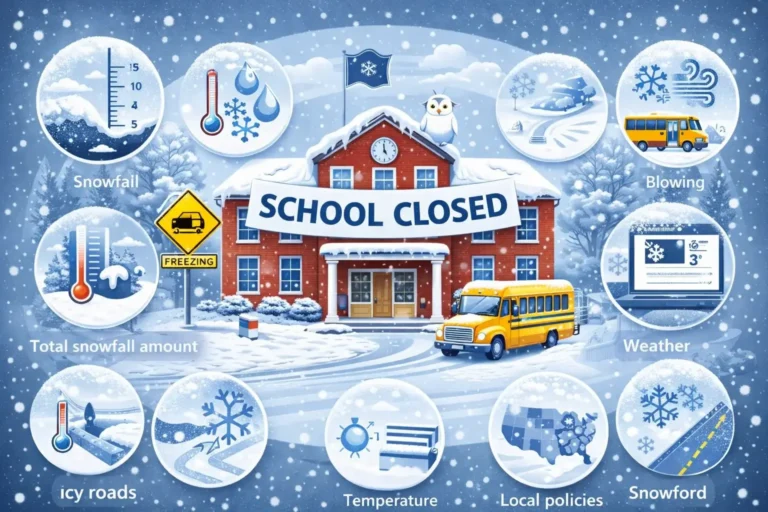
Snow may lead to school delays or closures, but snowfall amount alone does not determine whether a school will close.
Schools may consider:
- Road safety
- Ice and freezing rain
- Bus routes
- Overnight temperatures
- Expected snowfall during travel times
- Local road-clearing capacity
A mountain community used to frequent winter snow may handle a storm differently from a lower-elevation community.
For a general estimate during an incoming winter storm, the Snow Day Predictor can be used alongside official forecasts and school-district announcements.
The final closure decision always comes from the school or district.
For additional winter-weather guides and tools, visit Snow Day Calculators.
Idaho Snow Facts at a Glance
| Question | Short Answer |
|---|---|
| Does it snow in Idaho? | Yes, every winter |
| Does Boise get snow? | Yes |
| Boise normal annual snowfall | 17.6 inches at Boise Air Terminal |
| When does Idaho’s main snow season occur? | Generally November through March |
| Can Idaho get October snow? | Yes, especially at higher elevations |
| Can mountain snow continue into spring? | Yes |
| Does Idaho Falls get snow? | Yes |
| Is McCall snowy? | Yes, especially in winter |
| Does Island Park get snow? | Yes, with a long winter season |
| Where is snow most dependable? | Higher mountain areas |
| Does Idaho monitor snowpack? | Yes, through NRCS snow surveys and SNOTEL |
FAQs About Snow in Idaho
Does Idaho get a lot of snow?
Some areas do. Idaho’s mountains can receive deep seasonal snow, while lower valleys such as Boise receive much less.
How often does it snow in Idaho?
Snowfall frequency varies by location. Mountain communities generally experience more frequent snow than lower and drier valleys.
When does snow start in Idaho?
Snow can begin in the mountains during fall. Lower-elevation communities typically enter their main snowfall season later, often in November or December.
What month gets the most snow in Boise?
December has the highest 1991 to 2020 normal snowfall at Boise Air Terminal, at approximately 5.6 inches.
Does Idaho get snow in December?
Yes. December is a principal winter snowfall month across much of Idaho.
Does Idaho get snow in March?
Yes. March snowfall is possible in cities and remains common in many mountain areas.
Can it snow in Idaho in May?
Yes, especially in high mountains. May snowfall is not a normal expectation for Boise, but Idaho’s higher elevations can still experience late-season winter weather.
Does Boise get more snow than Idaho Falls?
The answer depends on the climate stations and measurement period being compared. Both cities get winter snow, but their regional climates differ.
Does Island Park have snow all winter?
Island Park commonly has a long winter snow season, but the timing and depth of snow cover vary from year to year.
Does Idaho have snowstorms?
Yes. Winter storms can bring significant snow, strong winds, reduced visibility, and difficult road conditions to parts of Idaho.
Where should I check Idaho snow depth?
Use the NRCS Idaho Snow Survey for mountain snow-depth observations and snowpack maps.
Understanding Snow in Idaho
Idaho is a snowy state, but its winter landscape changes sharply from one region to another.
Boise receives regular but relatively modest snowfall compared with the mountains. Eastern Idaho has cold winters, while places such as McCall, Island Park, and the high mountains of Northern and Central Idaho can maintain substantial snow for long periods.
For winter travel or snow activities, check the forecast for your exact destination and elevation. A statewide description can tell you what is typical, but current conditions determine what you will actually encounter.
Sources
- NOAA: Boise Air Terminal, 1991 to 2020 Climate Normals
- National Weather Service: Local Climate of the Treasure Valley and Boise
- National Weather Service: Boise Climate Records
- USDA NRCS: Idaho Snow Survey and Water Supply
- USDA NRCS: Idaho Current and Historical Conditions
- Idaho Department of Parks and Recreation: Snowmobiling
- Idaho 511: Official Road Conditions