Snow day websites often talk about high accuracy. Some claim they are right 80 or even 90 percent of the time.
Those numbers sound comforting. But most people never see how they are calculated. You only see a percentage on the screen and then wait for the school message.
Accuracy for snow days is not as simple as a right or wrong forecast. It sits on top of two moving parts. First is the weather. Second is the human decision made by each school district.
This post explains what accuracy really means for snow day calculators and predictors. It also shows how you should read those percentages in a safer and more realistic way.
What Does “Accuracy” Mean for a Snow Day Calculator?
Start with a simple picture.
A tool says there is a 70 percent chance of a snow day tomorrow. The next morning, schools either close or they do not.
There are only two outcomes in real life. Closure or no closure.
So what does 70 percent mean here. It does not mean the tool will be right seven days out of ten for you alone. It means that on many similar days, with similar inputs, closure should happen in roughly seven out of ten cases. To measure this in practice, a site needs data.
For example.
- Store the prediction for each day.
- Record whether schools actually closed or stayed open.
- Compare the forecast band with the real outcome.
Over time you can say things like.
- When we predicted over 80 percent, schools closed in most cases.
- When we predicted under 20 percent, schools almost never closed.
That is a more honest view of accuracy. It focuses on how well the bands behave, not on single days.
Why Snow Day Accuracy Is Harder Than Regular Weather Accuracy
Weather forecasts already deal with complex systems. But snow days add an extra layer of uncertainty.
With a normal forecast the outcome is direct. It either rains or it does not. You can measure the exact temperature and wind.
Snow days depend on people. School leaders decide based on safety, policy, history, and public pressure. Two districts under the same cloud can make opposite choices.
This creates a few problems.
- You may not have a clean record of past closures for every district.
- Different schools can react differently to the same snow.
- New leaders can change the style of decisions from one year to the next.
So even if the weather data is perfect, the final snow day call can surprise any tool. A good calculator tries to build in typical behaviour. It can never see every bus route, hill, or local rule.
Weather Data: The Foundation of Any Prediction
Even with all that human uncertainty, weather still sits at the base. If the forecast misses the storm, the snow day estimate will fail as well.
Most tools look at a few key items.
- Total expected snowfall or mixed precipitation.
- Timing of the heaviest band relative to school start time.
- Temperature during the morning commute.
- Wind speed and gusts.
- Risk of ice from freezing rain or refreezing.
If a storm shifts south overnight, a high snow day chance can drop quickly. If new data shows more snow and lower temperatures, the chance can rise. This is why you often see different numbers when you refresh a snow day predictor. The tool is not always changing its rules. It is responding to updated weather data underneath.
Algorithm Rules and Local Behaviour
Weather data feeds into rules. This set of rules is sometimes called the algorithm.
Basic rules might look like this in plain language.
- More snow raises the chance of closure.
- Snow that hits during the commute is more serious than snow that ends at midnight.
- Very icy conditions raise the chance more than light fluffy snow.
- Strong wind and poor visibility add more risk.
On top of this, better tools try to reflect local habits. That is the part many generic sites skip.
Some districts close schools often.
Some hold on as long as they can.
Some have many hills and rural roads.
Others sit in dense cities with strong plow coverage.
A calculator that lets you set “strict”, “normal”, or “relaxed” behaviour is trying to capture this. You can tell it whether your school tends to close early or late. That changes the final percentage.
Without this local flavour, a snow day tool may feel off. It might be right for the country on average, but wrong for you.
How Snow Day Tools Can Track and Improve Their Accuracy
To improve over time, a site needs feedback.
A simple way looks like this.
- After the day ends, users answer a short question.
- “Did schools close today in your area. Yes or No.”
- The tool links that answer to the prediction it made.
- Over weeks and months, patterns appear.
For example.
- Predictions above 80 percent might be right most of the time.
- Predictions between 60 and 80 percent might be right about half the time.
- Predictions below 20 percent might almost never lead to a snow day.
If the numbers do not behave that way, the site can adjust its rules. Maybe it is too aggressive for mixed precipitation. Maybe it underestimates how often districts close for ice.
This process works best when there is enough data. It may take several winters to refine things for many regions.
When a site talks about accuracy, the most honest claim is often based on bands.
Examples.
- “When our tool shows over 80 percent, schools close in about four out of five cases.”
- “When our tool shows under 20 percent, schools close in less than one out of ten cases.”
That kind of statement is easier to test than a single big number with no context.
How You Should Read Snow Day Percentages
For most people, the question is simple. You just want to know whether school is likely to close.
A percentage looks very precise. Your mind might treat 63 percent as very different from 57 percent. In practice, they sit in the same zone.
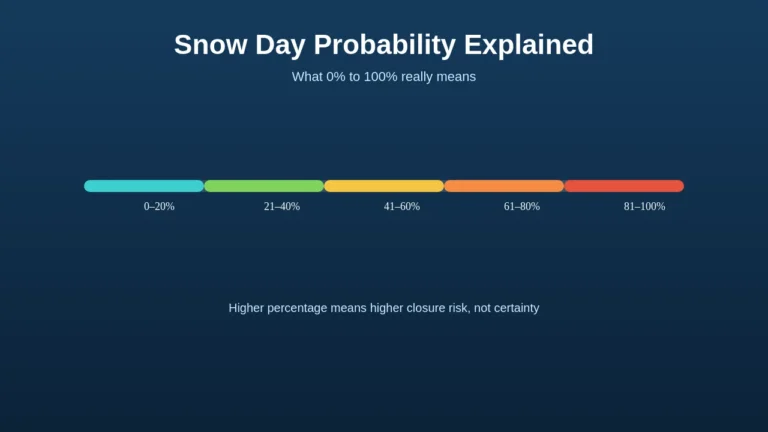
A more useful habit is to think in bands.
- Under 30 percent.
- Plan for school.
- Use normal routines.
- Between 30 and 60 percent.
- Prepare for school but stay flexible.
- Keep an eye on alerts and updates.
- Between 60 and 80 percent.
- Treat closure or delay as a real possibility.
- Start rough plans for backup childcare or schedule changes.
- Over 80 percent.
- Expect a snow day.
- Still wait for the official decision before final moves.
Try to pay attention to the trend as well.
If a tool moves from 35 to 55 to 70 percent as the storm gets closer, that says a lot.
The risk is building.
If it slides from 70 to 40 to 20 percent, it means the storm is weakening or shifting.
Your odds of a snow day drop, even if some snow still falls.
Limits of Any Snow Day Tool
No snow day calculator or predictor can see everything.
A few real world issues sit outside the model.
- Sudden accidents that block key roads.
- Power outages in parts of the district.
- Changes in policy after a bad event in a past winter.
- Small differences between neighbouring districts.
- Human error or caution that swings the call one way or the other.
Two schools in the same town can even make different choices. Private schools sometimes decide faster than public ones. Individual principals may have some freedom inside a district rule.
Because of this, even the best tool will miss some days. High percentages can miss when decision makers are stricter than expected. Low percentages can miss when leaders react strongly to a new risk.
How to Use Calculators and Predictors the Smart Way
The safest way to use any snow day calculator or predictor is as a planning tool.
Think of the percentage as a signal.
- Low signal. Carry on as normal.
- Medium signal. Stay flexible and watch alerts.
- High signal. Start gentle plans for a snow day.
Combine the number with what you know.
- Your district’s history.
- Your road conditions.
- Your trust in the latest forecast.
Check the tool more than once as the storm gets closer. Notice whether the odds are rising or falling.
Then wait for official messages from your school district. They always have the final word, no matter what any website says. When you keep these points in mind, you can get real value from snow day calculators and predictors. You will treat their accuracy in a fair way. You will also feel less stress each time winter puts that familiar question in your mind. Will there be a snow day tomorrow.
FAQ’s
What does it mean when a site claims 80 or 90 percent accuracy?
Often it means that across many days, predictions in a certain range matched real closures most of the time. Without details, the number can be vague. The most honest measures look at how prediction bands perform over many events, not at one single day.
Why is it harder to measure snow day accuracy than normal weather accuracy?
Weather can be measured directly, but snow days depend on human decisions. Two districts under the same storm can make opposite choices. Changes in policy, leadership, or public pressure can also affect decisions in ways no calculator can fully see.
Can snow day tools learn and improve over time?
Yes. If a site stores past predictions and compares them with real closures, it can adjust its rules. Over several winters, it can tune the way it handles snow amounts, timing, ice, and local habits to match outcomes more closely.
How accurate is a snow day calculator?
A snow day calculator is only as accurate as the weather data and rules behind it. In calm, well-forecast storms it can be close to real school decisions, especially when the percentage is very low or very high. In borderline cases, or when the forecast keeps changing, results are less reliable. Treat the number as a planning signal—low, medium, or high risk—not as a guarantee, and always confirm with your school or district.