Snow day calculators often show a percentage instead of a simple yes or no.
This number represents likelihood, not certainty.
Many parents and students misunderstand what snow day probability means. A 30% chance does not mean schools will stay open. An 80% chance does not guarantee a closure.
Snow day probability reflects changing weather conditions, forecast confidence, and local school decision patterns. These percentages help estimate risk, not predict outcomes with certainty.
This guide explains what snow day probability means from 0% to 100%, how to interpret different ranges, and what actions make sense at each level.
What Is Snow Day Probability?
Snow day probability is an estimate of how likely it is that schools will close due to winter weather.
check the snow day probability for your area
The percentage reflects risk, not a guaranteed outcome. A low percentage means closure is unlikely, while a higher percentage means conditions favor a possible closure.
Snow day probability combines weather forecasts, timing of storms, and local decision patterns. It adjusts as forecasts change and new data becomes available.
Because school closure decisions are made by people, not computers, probability should be used as guidance rather than a final answer.
How Snow Day Probability Is Calculated
Snow day probability is based on several weather and safety signals, not a single factor.
Forecast models provide data on snowfall amount, timing, and intensity.
Overnight snow and freezing rain usually increase risk more than light daytime snow.
Temperature and wind also play a role. Cold conditions affect how roads are treated, while wind can reduce visibility and cause drifting snow. Ice risk is especially important, since even small amounts of freezing rain can quickly make travel unsafe.
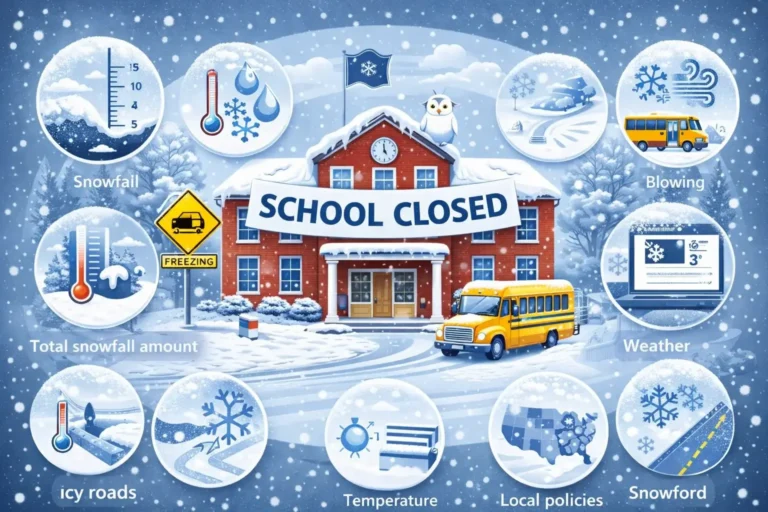
In addition to weather, school decisions depend on the factors schools consider before closing, including transportation safety, local infrastructure, and past closure behavior. Some districts act earlier than others based on experience.
As forecasts update, snow day probability can change. This is why percentages often shift overnight or early in the morning as conditions become clearer.
What Different Snow Day Percentages Mean
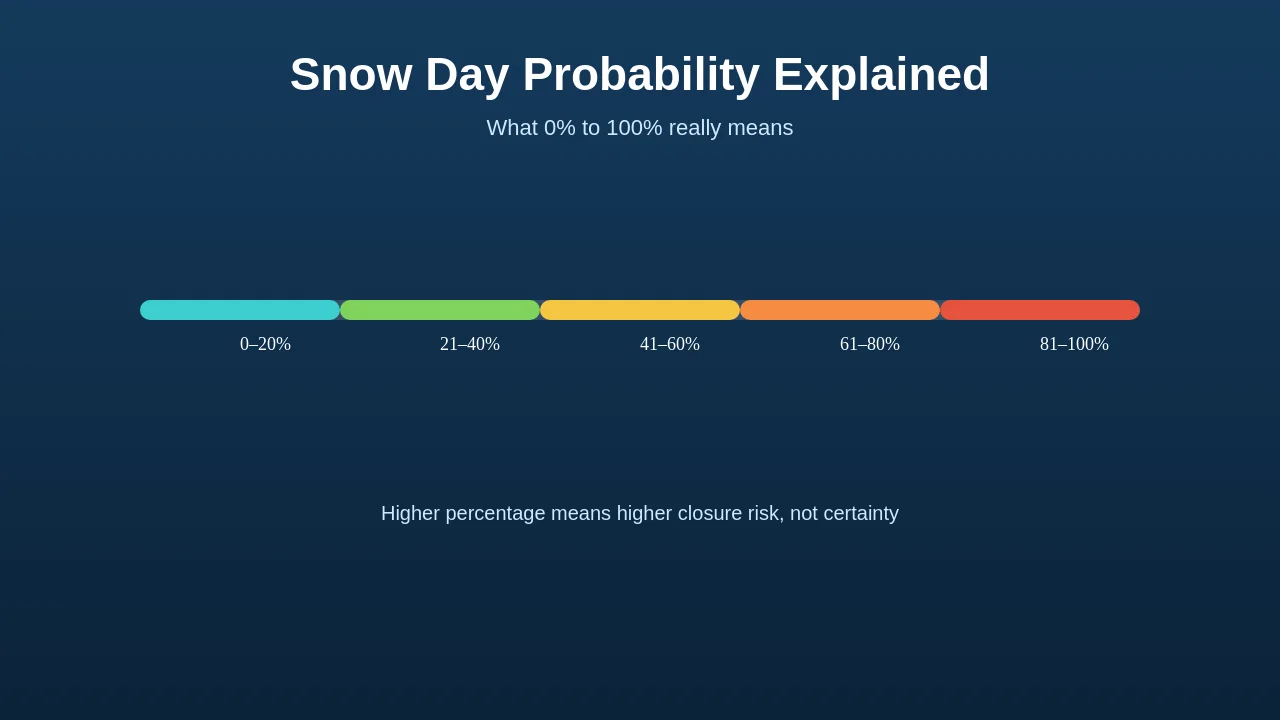
Snow day percentages describe likelihood, not certainty. Each range suggests a different level of risk and preparation.
0%–20% Snow Day Probability
This range means the chance of a school closure is very low.
Weather conditions are usually mild or uncertain. Schools almost always remain open, though minor delays are still possible in rare cases.
At this level, no special preparation is usually needed.
21%–40% Snow Day Probability
This range indicates a possible but unlikely closure.
Forecasts may show light snow, mixed precipitation, or timing uncertainty. Conditions can still change, especially overnight.
Families should stay alert and check updates, but schools typically remain open.
41%–60% Snow Day Probability
This range signals moderate risk.
Weather conditions are becoming more favorable for closures. Delays, early dismissals, or partial closures are more common in this range.
It is a good time to start planning alternatives and monitor official announcements closely.
61%–80% Snow Day Probability
This range suggests a high chance of closure.
Forecasts usually show significant snow, ice risk, or dangerous travel conditions. Many schools prepare for closure at this level.
Families should expect updates and prepare for a possible snow day.
81%–100% Snow Day Probability
This range indicates a very high likelihood of closure.
Conditions strongly favor unsafe travel. Closures are common, though last-minute changes are still possible.
Even at this level, final decisions depend on school districts and real-time conditions.
Is a 40% Chance of a Snow Day High?
A 40% snow day probability is considered moderate, not high.
This range means conditions could lead to a closure, but there is still a strong chance schools will remain open. Forecasts at this level often include light snow, mixed precipitation, or uncertainty about timing.
At 40%, families should stay alert but avoid assuming a closure. Checking updates later in the evening or early morning provides a clearer picture as forecasts improve.
This range is common during developing storms when small changes can shift outcomes quickly.
Why Snow Day Probability Changes Overnight
Snow day probability often changes overnight because weather forecasts become more accurate closer to the event.
As a storm approaches, meteorologists receive updated data from radar and weather models. This helps refine snowfall totals, timing, and ice risk.
Temperature changes overnight also matter. Roads can cool faster than expected, increasing the chance of ice formation by morning.
Wind patterns may shift, affecting visibility and snow drifting. Even small changes can raise or lower travel risk.
School districts also review updated information early in the morning. Their decisions can influence how probability is interpreted as conditions become clearer.
Because of these factors, checking snow day probability again in the early morning often provides the most reliable estimate.
Common Mistakes When Reading Snow Day Percentages
One common mistake is treating probability as certainty. A high percentage does not guarantee a closure, and a low percentage does not rule one out. Snow day probability reflects likelihood, not final decisions.
Another mistake is assuming results stay fixed. Prediction accuracy depends on forecast stability which means percentages can change as new data becomes available. This is especially true when storms develop quickly or ice risk increases.
Some people ignore ice risk and focus only on snowfall totals. Ice often plays a larger role in closure decisions than snow depth.
Comparing percentages between different districts can also be misleading. Each district follows its own policies and risk tolerance.
Understanding these limitations helps avoid false expectations.
What Action to Take at Each Probability Range
Snow day probability is most useful when it guides practical decisions, not assumptions. Here is how families can respond at each range.
0%–20% Probability
Schools are very likely to remain open.
Normal routines usually continue. It is still a good idea to check the forecast, but no special planning is required.
21%–40% Probability
A closure is possible but not expected.
This is a good time to stay informed. Check updates in the evening and again in the morning. Avoid making firm plans yet.
41%–60% Probability
Risk is moderate.
Families should begin planning alternatives, such as childcare or remote work options. Delays or early dismissals are more common at this level.
Monitor official school announcements closely.
61%–80% Probability
A closure is likely.
Prepare for a snow day. Arrange schedules, charge devices, and expect updates from the school district.
Avoid assuming a delay instead of a closure, especially if ice is involved.
81%–100% Probability
A closure is very likely.
Unsafe travel conditions are expected. Most districts close schools in this range, though final confirmation still comes from official announcements.
Continue checking updates until the decision is confirmed.
Snow Day Probability vs Official School Announcements
Snow day probability helps estimate risk, but it does not replace official decisions.
School districts make closure decisions based on real-time conditions, safety reports, and transportation readiness. These decisions may override earlier forecasts or probability estimates.
Weather conditions can improve or worsen quickly. A high probability may drop if roads remain clear. A low probability may rise if ice forms unexpectedly.
For this reason, snow day probability should be used as a planning tool. Always rely on official school announcements for final confirmation.
Frequently Asked Questions
Final Thoughts
Snow day probability helps explain risk, not outcomes. Percentages reflect changing weather conditions, forecast confidence, and local decision patterns. Higher numbers suggest greater risk, but no value guarantees a closure.
The best way to use snow day probability is as a planning tool. Check updates as conditions change and always confirm decisions through official school announcements.
Understanding what these percentages mean reduces confusion and helps families prepare more confidently during winter weather.