How Cold Does It Have to Be to Cancel School?
There is no national temperature that automatically cancels school. No federal rule, no state law, no universal number. Each district sets its own threshold, and most of them do not publish it publicly.
That said, a consistent pattern exists across the US and Canada. Most school districts start seriously considering closure when wind chill drops to -20°F (-29°C). Closures become very likely around -30°F to -35°F (-34°C to -37°C). Below that, widespread cancellations are almost certain.
The number that matters is almost never the thermometer reading. It is the wind chill.
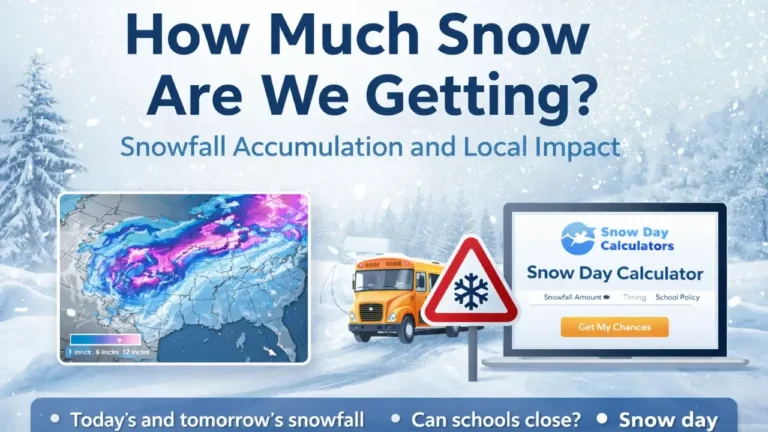
Use our Snow Day Predictor to check your school’s closure probability for tomorrow based on tonight’s forecast.
Why Wind Chill Matters More Than Air Temperature
Wind chill measures how fast your body loses heat in cold, moving air. An air temperature of 5°F (-15°C) with a 20 mph wind creates a wind chill of -15°F (-26°C). Those are two very different situations for a child standing at a bus stop.
The National Weather Service wind chill formula accounts for this. At -20°F wind chill, exposed skin can develop frostbite in about 30 minutes. At -30°F, that window drops to 10 minutes. At -40°F, frostbite can set in within 5 minutes.
Children standing outdoors waiting for a school bus are directly exposed. That is why wind chill drives most cold-day closure decisions, not the air temperature alone.
Wind Chill Thresholds: What Usually Happens at Each Level
| Wind Chill | What Most Districts Do |
|---|---|
| 0°F to -10°F (-18°C to -23°C) | Schools stay open. Recess may move indoors. |
| -10°F to -20°F (-23°C to -29°C) | Most districts open. Some issue cold weather advisories. |
| -20°F to -25°F (-29°C to -32°C) | Delays or closures possible. Northern districts may stay open. |
| -25°F to -35°F (-32°C to -37°C) | High probability of closure in most districts across North America. |
| Below -35°F (-37°C) | Near-certain closure. Dangerous exposure risk even for brief periods. |
These are patterns, not rules. A Wisconsin district may stay open at -25°F wind chill without hesitation. A district in Kentucky or Tennessee may close at 10°F because their infrastructure and student population is not equipped for those conditions.
The Four Real Factors Behind a Cold-Day Closure
1. Wind Chill and Frostbite Risk at Bus Stops
The morning commute window is the most critical factor. Superintendents are specifically thinking about children waiting outdoors between 6:30 AM and 8:30 AM. A sustained wind chill in the dangerous range during that window is the primary trigger.
Districts in areas where many students walk to school lower their closure threshold further. A Bangor, Maine district administrator put it directly: when students walk, they drop the temperature threshold because the exposure time is longer.
2. Bus Diesel Fuel Performance
This one surprises most people. Diesel fuel begins forming wax crystals at around 15°F (-9°C). Those crystals clog fuel filters and cause engines to stall. A school bus stalling on a rural route with children aboard in -25°F temperatures is a serious emergency.
Transportation directors typically start buses between 3:00 AM and 4:00 AM on cold mornings specifically to test whether they will run. If buses cannot start or run reliably, closing school becomes straightforward regardless of the official wind chill reading.
3. Building Heating Capacity
Older school buildings have boilers and heating systems that struggle in extreme cold. A building that holds 70°F comfortably at 15°F outside may drop to 55°F inside when the temperature hits -20°F. If the building cannot stay warm enough for a full school day, keeping it open becomes impractical.
Administrators check morning building temperatures and heating forecasts as part of the same decision process. Some districts keep buildings open for their first period but send students home early when heating projections look bad for the afternoon.
4. Student Gear and Equity
Many districts, particularly in lower-income areas, factor in whether students have access to appropriate winter gear. A child without a proper winter coat, gloves, or boots faces a real safety risk at -10°F wind chill that a well-equipped child does not.
This consideration does not override the others, but it does lower the closure threshold in districts with higher proportions of students who may not have adequate cold-weather clothing.
Cold Day vs. Snow Day: What Actually Closes School?
These are different closure types, and most districts handle them separately.
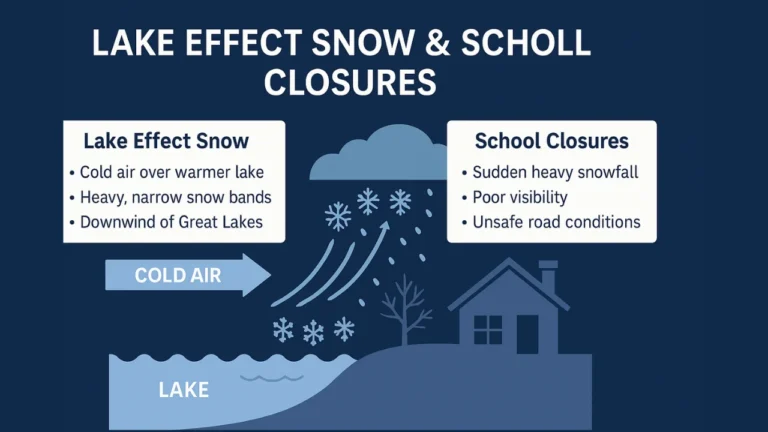
Snow day: School closes because of road conditions, accumulation, blowing snow, or ice. Snowfall is the primary driver.
Cold day: School closes because of extreme temperatures or wind chill, even with no new snowfall. Roads may be perfectly clear.
Ice day: Freezing rain or black ice creates hazardous road conditions. Often worse than a heavy snowfall from a transportation standpoint, because ice affects every surface, not just unpaved roads.
A cold morning can become a snow day if precipitation arrives simultaneously. The combination of -15°F wind chill and 8 cm of overnight snowfall will almost always close school.
Why Two Schools in the Same City Decide Differently
This confuses a lot of people. Two districts in the same metro area can get identical weather and make opposite decisions.
Several factors cause this.
Different building stock. A newer district with modern, energy-efficient buildings can keep students warm in conditions that would make an older district’s aging boiler system inadequate.
Different bus fleets. Newer diesel engines with block heaters perform better in extreme cold than older equipment.
Different route geography. An urban district with short, dense bus routes faces less risk than a rural district where students ride for 45 minutes on exposed county roads.
Different historical policy. A district that historically stayed open in cold weather faces community and school board pressure to maintain that standard. Changing policy is a political decision as much as a safety one.
Different student demographics. As noted above, student access to winter gear affects the threshold calculation in some districts.
There is no single number on the thermostat that makes the decision. Two experienced superintendents looking at the same forecast can reach different conclusions in good faith, based on their specific district conditions.
How Extreme Cold Decisions Work in Canada
Canadian school boards use the same wind chill logic but reference Environment Canada thresholds rather than NWS guidelines.
Environment Canada issues Extreme Cold Warnings when wind chill is expected to reach -40°C (-40°F) or colder. At that level, exposed skin can freeze in under two minutes.
Canadian school boards typically close at wind chills between -35°C and -40°C (-31°F to -40°F), though northern Ontario boards in cities like Sudbury, Timmins, and Thunder Bay sometimes stay open longer because their communities are acclimatised and equipped for extreme cold.
In southern Ontario, boards like TDSB (Toronto) and OCDSB (Ottawa) rarely close for cold alone. Ottawa receives more extreme cold events than Toronto, but the board has historically built around those conditions. When closures do happen in Ottawa for cold, it is typically combined with a wind event or significant snowfall.
Atlantic provinces like New Brunswick and Nova Scotia face a different situation. Freezing rain, not extreme cold, is their primary winter weather risk. A -10°C day with freezing rain is more dangerous for school bus operations than a -30°C clear day in most Atlantic Canadian communities.
How the Decision Process Actually Works on a Cold Morning
Most superintendents and board administrators follow a similar timeline.
- 3:00 – 4:00 AM: Transportation staff start buses and test performance. Road check drivers assess conditions on major bus routes.
- 4:00 – 5:00 AM: Building managers check heating system performance and indoor temperatures. Forecast models are reviewed for the 6:30 AM to 9:00 AM commute window.
- 5:00 – 5:30 AM: The superintendent or district director makes the closure decision based on transportation, building, and weather reports.
- 5:30 – 6:30 AM: Closures are announced via district website, automated phone and email notifications, local radio, and social media.
The decision is rarely reconsidered after 5:30 AM. If conditions worsen after buses have already started running, districts may issue early dismissal rather than a full closure.
Cold Weather Policies by Region
Upper Midwest and Great Plains (Minnesota, Wisconsin, North Dakota, Michigan)
These states have the most experience with extreme cold. Most districts in Minnesota, Wisconsin, and the Dakotas stay open at -20°F to -25°F wind chill. The Green Bay Area Public School District in Wisconsin closes or considers a delayed start at sustained wind chill of -35°F. That threshold is typical for this region.
Northeast and Great Lakes (New York, Massachusetts, Pennsylvania, Ohio)
More variation here. Urban districts in New York City rarely close for cold alone. Ohio districts vary significantly. The Cleveland Metropolitan School District’s playbook states schools will usually remain open when the ambient air temperature is below zero, with the decision made by 5 AM if not called the night before.
Southern States (Tennessee, Kentucky, Georgia, Texas)
Cold days hit southern states hard because their infrastructure is not built for extreme cold. School buildings, water pipes, and bus systems are not designed for sustained temperatures below 20°F (-7°C). Closure thresholds in these states are significantly higher, meaning they close at conditions that would be routine in Minnesota.
Canada (Ontario, Quebec, Prairie Provinces)
Northern boards in Ontario, Manitoba, and Saskatchewan close when sustained wind chill reaches -40°C. Southern boards close earlier, typically around -35°C, especially when cold combines with precipitation. Prairie provinces have the most extreme cold events in the country. Wind chill warnings at -45°C to -50°C have triggered multi-day closures in Edmonton and Winnipeg.
What This Means for Parents Checking Tonight’s Forecast
If your weather app shows:
Air temp above 0°F (-18°C) with calm wind – School almost certainly opens.
Air temp around 0°F (-18°C) to -10°F (-23°C) with moderate wind – Wind chill may be in the -15°F to -20°F range. Northern districts likely open. Southern districts may delay.
Wind chill around -20°F to -25°F (-29°C to -32°C) – High possibility of delays or closures. Check your district’s website from 5:30 AM.
Wind chill below -30°F (-34°C) – Very high probability of closure for most districts. Use our Snow Day Calculator to check your specific area’s estimate.
FAQs
Final Thought
The answer to “how cold does it have to be to cancel school” is always local. Wind chill around -20°F to -35°F is where most of North America starts closing schools, but the specific number depends on your district’s buildings, buses, student population, and policy history.
Check your district’s website for any published cold-weather policy. Then use our Snow Day Predictor for tomorrow’s closure estimate based on tonight’s actual forecast for your location.