Lake Effect Snow: What It Is, How It Forms, and Where It Hits Hardest
Lake effect snow is one of the most localized and intense weather patterns in North America. It can drop three feet of snow on one side of a city while the other side sees nothing. It shuts down highways, cancels school for days, and catches drivers completely off guard because it builds fast and stalls in place.
This page explains what lake effect snow is, why it forms the way it does, which cities and regions get hit hardest, and what the warning levels actually mean. Use our Snow Day Predictor to check your school closure probability during active lake effect events.
What Is Lake Effect Snow?
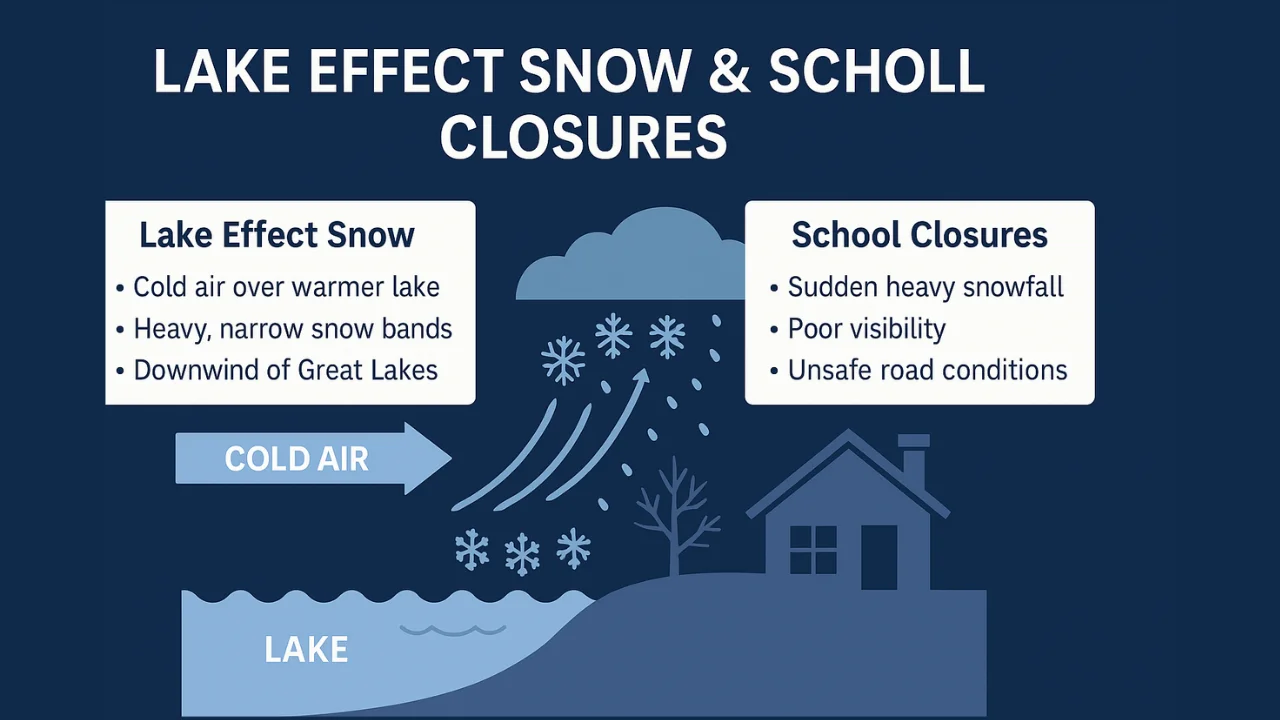
Lake effect snow forms when cold, dry air moves across the relatively warm, open water of a large lake. The lake surface transfers heat and moisture into the cold air mass above it. That air becomes unstable, rises, cools, and releases the accumulated moisture as snow over land.
The result is not a wide snowstorm. It is a narrow band of extremely heavy snowfall, sometimes only 10 to 15 miles wide, delivering two to three inches per hour or more at its peak. That band can stall over the same community for hours or even days, stacking up several feet of snow in a concentrated area.
Wind direction controls everything. A slight shift in the wind can move the snow band five miles north or south, instantly changing who gets buried and who sees sunshine.
What Causes Lake Effect Snow – Step by Step
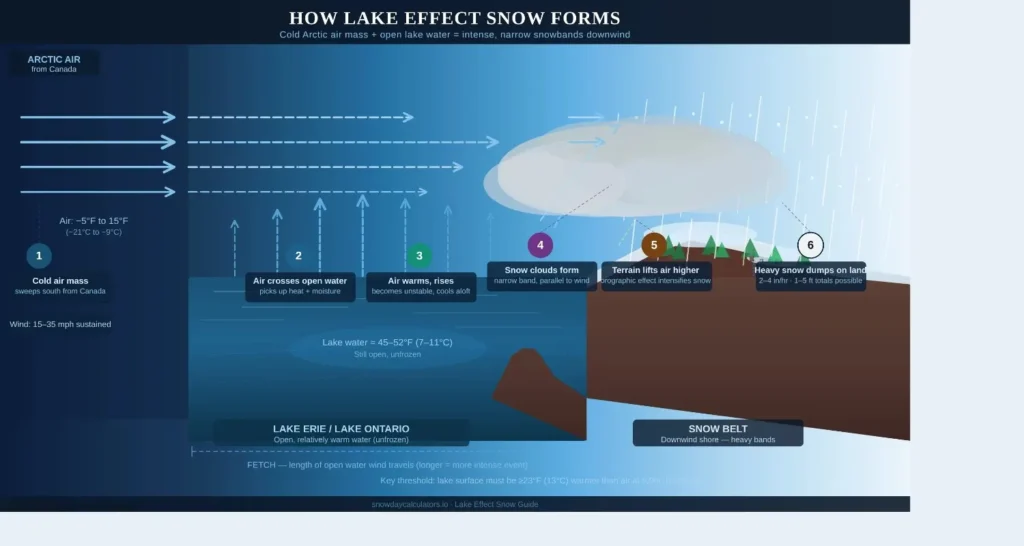
Understanding the mechanics helps you read a forecast during an active event.
- Cold air mass arrives. Arctic air, often originating from Canada, pushes south across the Great Lakes region. This typically follows a polar vortex intrusion or Alberta clipper system.
- Air passes over open lake water. The lake water is significantly warmer than the incoming air. Water holds heat longer than air does, so even in October and November, lake surface temperatures may be 40°F to 50°F (4°C to 10°C) while air temperatures above are near or below freezing.
- Heat and moisture transfer. The lake warms and moistens the lowest layer of the air mass. Evaporation is intense. Fog sometimes forms at the shoreline during the initial contact.
- Unstable air rises. The warmed, humid air becomes less dense and rises rapidly. As it rises, it cools. Cooler air cannot hold moisture, so clouds form and grow.
- Bands develop. Long, narrow cloud bands form parallel to the wind direction. These bands intensify if they pass over a long stretch of open water, called the fetch.
- Snow falls over land. As the band crosses the shoreline, it dumps its moisture as snow. Terrain elevation amplifies the effect. Hills and higher ground on the downwind shore force air upward even faster, squeezing out more snow.
The longer the fetch, the more moisture the air picks up. Wind blowing the length of Lake Ontario or Lake Erie picks up far more moisture than wind crossing the short axis.
Lake Effect Snow vs Regular Snow – What Is the Difference?
Most winter storms form within large weather systems that meteorologists can track days in advance. They produce snowfall across a wide geographic area, and totals are relatively predictable.
Lake effect snow works differently in four key ways.
Width. A lake effect band is 10 to 30 miles wide. A winter storm may produce snow across hundreds of miles. You can drive out of a lake effect band in 15 minutes while it continues burying your neighborhood.
Intensity. Snowfall rates of two to four inches per hour are common during intense lake effect events. Major winter storms rarely produce sustained rates that high.
Duration. A lake effect band can stall for 24 to 48 hours or longer over the same area. A typical winter storm passes through in several hours.
Predictability. Wind direction drives everything. A 10-degree shift moves the entire snow band. Even experienced meteorologists acknowledge that precise placement of lake effect bands is difficult to pin down more than six to twelve hours ahead.
Is lake effect snow heavy or fluffy?
It depends on temperature. Lake effect snow forming in very cold air (below 20°F / -7°C) is typically dry and fluffy, blowing easily into drifts. Lake effect events in marginally cold air (near 28°F to 32°F / -2°C to 0°C) produce heavier, wetter snow. The November 2014 Buffalo event produced extremely dense, wet snow that collapsed roofs under its weight.
Why Lake Effect Snow Is Dangerous
Lake effect snow earns its reputation for a specific reason. It is not just how much falls. It is how fast it falls, how suddenly it starts, and how little warning drivers get.
Whiteout conditions can develop within minutes as a snow band crosses a highway. A driver in clear conditions can enter a band and lose visibility to near zero before there is any chance to pull over safely. Lake effect squalls along interstate corridors in western New York, northeast Ohio, and northwest Pennsylvania are responsible for serious multi-vehicle accidents every winter.
Additional hazards include:
- Power outages. Wet, heavy lake effect snow loads trees and power lines. The 2014 Buffalo event caused widespread structural failures across Erie County.
- Road ice. Snow falling on cold pavement in narrow bands creates rapid icing that plows and salt trucks cannot keep up with.
- Travel bans. Counties and municipalities in lake effect zones issue travel bans during severe events. Erie County in western New York and Oswego County in central New York have each issued multiple bans during extreme events.
- Building load. Snowfall rates of three to four inches per hour over twelve or more hours can deposit two to four feet of snow on flat roofs. Several building collapses in Erie County were directly attributed to the 2014 event.
Lake Effect Snow Warning, Watch, and Advisory – What Each One Means
The National Weather Service issues specific alerts for lake effect snow events. These are separate from general winter storm warnings.
Lake Effect Snow Watch: Conditions are favorable for a significant lake effect event in the next 24 to 72 hours. Accumulations of 7 or more inches in 12 hours are possible. Prepare now and watch for updates.
Lake Effect Snow Warning: Heavy lake effect snow is imminent or occurring. Bands are producing significant accumulations and sudden visibility restrictions. Travel is hazardous or impossible in the warning zone. This is the highest lake effect alert level.
Lake Effect Snow Advisory (or Winter Weather Advisory for lake effect): Lake effect snow showers are expected but below warning criteria. Accumulations of 4 or more inches are possible in localized areas. Travel will be difficult in some locations. Some bands may be intense enough to briefly create dangerous conditions.
Winter Storm Watch with lake effect: Used when a lake effect event is expected to combine with a broader winter storm system, potentially producing exceptional snowfall totals across a wider area.
The boundaries on any lake effect warning map are approximate. The actual snow band is often narrower than the warning zone. Being inside a warning zone does not guarantee heavy snow. Being just outside it does not guarantee you are safe. Wind shifts can and do move bands across county lines.
Where Does Lake Effect Snow Occur? The Great Lakes Snow Belt
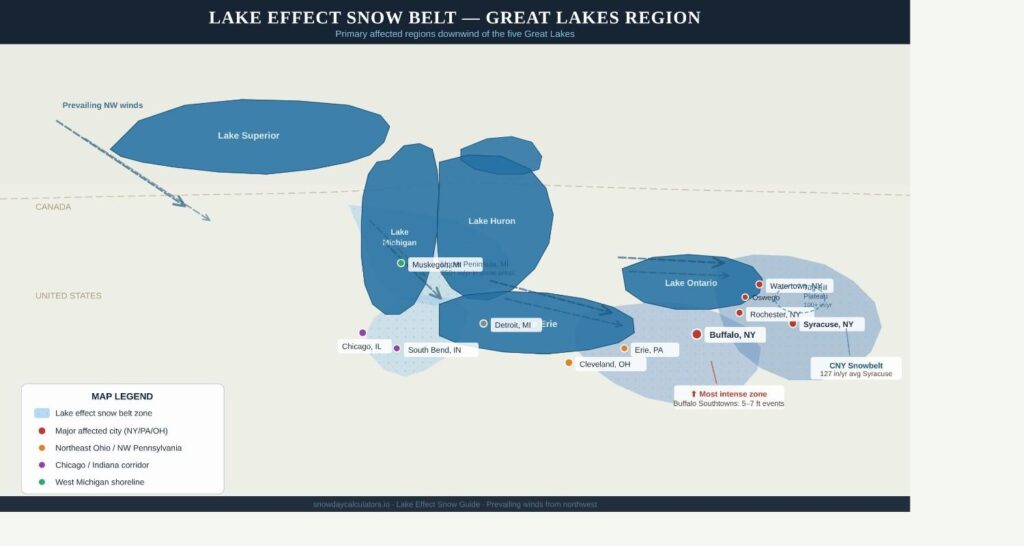
Lake effect snow occurs primarily downwind of the five Great Lakes: Superior, Michigan, Huron, Erie, and Ontario. Prevailing westerly winds drive cold air across each lake and dump snow on the eastern and southeastern shores.
The resulting geographic zones are called snow belts, sometimes written as snowbelts.
Lake Erie Snow Belt – Buffalo, Northeast Ohio, and Northwest Pennsylvania
Lake Erie is the shallowest of the Great Lakes. It freezes most completely each winter, which limits lake effect snow production after January. But from October through January, Lake Erie generates some of the most intense lake effect events anywhere in the world.
Western New York (WNY) and the Buffalo Southtowns sit directly in the path of Lake Erie’s dominant wind trajectory. When wind blows from the southwest or west-southwest across the long axis of Lake Erie, the band targets the Buffalo Southtowns, including Hamburg, Orchard Park, Eden, and surrounding areas. Wind from a more southerly direction pushes the band northeast toward Cheektowaga, Amherst, or Lockport.
The Southtowns of Erie County are the most frequently hit area in the Lake Erie snow belt. Snowfall rates of four inches per hour and multi-day totals of four to six feet are documented events, not anomalies.
Northeast Ohio, including Cleveland, Ashtabula County, Lake County, Geauga County, and Portage County, sits directly downwind of Lake Erie. The terrain rises inland from the lake, which enhances snowfall through orographic lift. Cleveland itself receives significant lake effect snow, though less extreme than the Buffalo area because it sits on the western end of Lake Erie where fetch is shorter under typical wind patterns.
Northwest Pennsylvania, particularly Erie County and Crawford County, sits in the Lake Erie snow belt and receives heavy lake effect snowfall during northwest wind events.
Lake Ontario Snow Belt – Syracuse, Watertown, and the Tug Hill Plateau
Lake Ontario does not freeze as completely as Lake Erie. It produces lake effect snow from late October well into February and sometimes beyond.
Wind blowing from the northwest across Lake Ontario targets a corridor running from Oswego County through Onondaga County and into Madison and Oneida Counties. The Tug Hill Plateau, rising to roughly 2,000 feet above sea level just east of Lake Ontario, is one of the snowiest places in the eastern United States.
Watertown and Oswego sit at the base of this corridor and receive some of the highest annual snowfall totals of any city their size in the country. Syracuse, further inland, is historically one of America’s snowiest large cities, averaging around 127 inches per year, largely due to Lake Ontario lake effect.
The state of New York holds the official 24-hour snowfall record at 50 inches, set in Camden in February 1966 during a Lake Ontario lake effect event.
Rochester sits at the base of Lake Ontario’s western shore. It receives significant lake effect snow from Lake Ontario under northeast wind patterns, which are less common but can produce heavy accumulations.
Central New York refers broadly to the area including Onondaga, Madison, Oneida, and Oswego Counties. This region gets hit by both westerly Lake Ontario events and occasionally Lake Erie moisture carried further east.
Lake Michigan Snow Belt – West Michigan, Chicago, Indiana, and Wisconsin
Lake Michigan generates lake effect snow that primarily affects west Michigan shoreline communities and the Chicago metro area.
West Michigan communities including Muskegon, Ludington, and Benton Harbor sit directly on the eastern shore of Lake Michigan and receive heavy lake effect snow from northwest and west winds. Annual snowfall totals in Muskegon average around 87 inches compared to Detroit’s 45 inches, a difference almost entirely explained by lake effect enhancement.
Berrien County in southwest Michigan sits at the bottom of Lake Michigan’s eastern shore and receives lake effect snow from northerly wind patterns.
Chicago and the surrounding metro area can receive lake effect snow when wind blows onshore from the northeast or east across Lake Michigan. These events are less frequent than those in west Michigan but can produce significant accumulations. The city has received lake effect events producing five to nine inches in a single band event.
Northwest Indiana, particularly the South Bend and Michigan City areas, sits at the southern end of Lake Michigan. South Bend is one of the snowiest cities in Indiana, receiving lake effect snow from northerly winds blowing the length of Lake Michigan.
Southeast Wisconsin and Milwaukee can receive lake effect snow from Lake Michigan under easterly or northeasterly wind patterns.
Lake Superior Snow Belt – Upper Peninsula of Michigan
Lake Superior is the deepest and least frequently frozen of the Great Lakes. It generates lake effect snow nearly all winter in some years. The Upper Peninsula of Michigan receives some of the highest annual snowfall totals in the eastern United States, with some communities exceeding 250 inches per year. The Keweenaw Peninsula, Porcupine Mountains area, and Whitefish Point corridor represent the most extreme snowfall zones.
Lake Effect Snow by City – Does Your City Get It?
Does Buffalo Get Lake Effect Snow?
Yes. Buffalo is the most documented lake effect snow city in the United States. It sits directly downwind of Lake Erie under the most common wind trajectories. The city averages over 90 inches of snow per year, much of it from lake effect events.
The most famous single event is Snowvember 2014, when two back-to-back lake effect storms dropped over 65 inches in the Buffalo Southtowns between November 17 and November 21. Snowfall rates reached four to six inches per hour in the most intense bands. Thirteen people died. Thousands of motorists were stranded. The NFL relocated a Bills game to Detroit. The storm produced the most significant structural failure events in Erie County history.
A November 2022 lake effect event buried the Buffalo area with up to 81 inches, making it one of the top-three highest-total lake effect events in the region’s recorded history.
Does Cleveland Get Lake Effect Snow?
Yes. Cleveland receives lake effect snow from Lake Erie, though with less extreme intensity than the Buffalo area. Under northwest wind patterns, bands track along the Lake Erie shoreline and target communities in Lake, Ashtabula, Geauga, and Portage Counties more directly than Cleveland proper. The city does see lake effect events, particularly in the snow belt communities east of downtown.
Does Chicago Get Lake Effect Snow?
Yes, though less frequently than Great Lakes eastern shore cities. Chicago and the northern Illinois lakefront can receive lake effect snow from Lake Michigan during northeast to east wind events. These events are real and can drop several inches in the lakefront zones while areas 20 miles inland see little to nothing.
Does Detroit Get Lake Effect Snow?
Minimally. Detroit sits on the western end of the Great Lakes influence zone and does not receive significant direct lake effect snow. Annual snowfall averages around 45 inches. Southwest Michigan communities receive far more due to their position on Lake Michigan’s eastern downwind shore.
Does Pittsburgh Get Lake Effect Snow?
Indirectly. Pittsburgh is far enough inland that it does not receive direct lake effect snow from Lake Erie or Lake Ontario. However, moisture carried by dissipating lake effect bands occasionally enhances snowfall totals in the Pittsburgh area during active events.
Does Toronto Get Lake Effect Snow?
Yes. Toronto and surrounding communities in Southern Ontario sit on the northwestern shore of Lake Ontario. When wind blows from the south across Lake Ontario, lake effect snow can target the Toronto area. However, the more common Lake Ontario wind direction puts Toronto in a less favorable position. Communities further east, like Kingston and Brighton, receive more frequent Lake Ontario lake effect snow.
Does Columbus Ohio Get Lake Effect Snow?
No. Columbus is well south of the Lake Erie snow belt and does not receive lake effect snow directly. It receives winter storm snowfall from broader weather systems but not lake-generated bands.
Does Lake Effect Snow Happen in Nevada?
Yes, though the lake involved is different. The Great Salt Lake in Utah generates lake effect snow that occasionally reaches into Nevada and affects communities like Salt Lake City. These events are called Great Salt Lake effect snow and are well-documented by the National Weather Service in Salt Lake City. The Black Sea also generates lake effect snow for coastal communities in Turkey, Bulgaria, and Romania under the right atmospheric conditions.
How Far Does Lake Effect Snow Travel?
Most lake effect moisture falls within 25 miles of the downwind shoreline. However, under strong wind conditions with a well-organized, persistent band, lake effect snow can reach 100 miles inland before the band weakens.
The snow band loses intensity as it travels inland because it loses contact with the lake moisture source and encounters increasing friction from land surfaces. Terrain elevation on the downwind shore determines how quickly the band intensifies after crossing the water. Flat terrain near the shoreline allows a band to maintain its organization further inland than areas where hills quickly dissipate the moisture.
Lake Effect Snow and Thanksgiving Travel
Late November is one of the most dangerous periods for lake effect snow. Lake water temperatures are still relatively warm from summer, while Arctic air masses begin making sustained intrusions across the Great Lakes. The temperature contrast between lake surface and air above is at or near its seasonal maximum in November.
Thanksgiving travel coincides directly with this peak window. The 2014 Snowvember disaster struck during the week before Thanksgiving. Lake effect events affecting Thanksgiving travel are documented in western New York, northeast Ohio, northwest Pennsylvania, and west Michigan nearly every year.
If you are driving through lake effect country during Thanksgiving week, monitor the National Weather Service forecast for your specific route. Conditions can shift from clear to zero visibility within seconds when crossing an active band.
When Does Lake Effect Snow Stop?
Lake effect snow production slows significantly when the lakes begin to ice over, typically in January and February for Lake Erie and later for the other Great Lakes. When the lake surface is covered with ice, the temperature contrast between water and air disappears, and moisture transfer stops.
Lake Erie freezes most completely and most consistently, shutting down lake effect snow earliest in the season. In some years, Lake Erie is over 90% ice-covered by mid-January.
Lake Ontario, Lake Michigan, and especially Lake Superior freeze less completely. Lake Superior can remain largely open all winter, which is why the Upper Peninsula of Michigan can receive lake effect snow throughout the entire winter season.
Climate change is altering this pattern. Warmer Great Lakes water temperatures and reduced ice cover are extending the lake effect snow season in many areas and increasing the intensity of individual events.
Lake Effect Snow Forecast – How Meteorologists Predict It
Forecasting lake effect snow is significantly more difficult than forecasting a standard winter storm. Several variables interact in ways that are hard to model.
Lake surface temperature: Warmer lake water produces more intense events. Forecast models incorporate daily lake temperature readings.
Wind direction and speed: Even small changes in wind direction shift the band location significantly. A 10-degree shift over Lake Erie can move the primary snow band 20 miles north or south.
Atmospheric stability: The temperature difference between the lake surface and the air roughly 5,000 feet above (called the 850-hPa level) drives how strongly air rises over the lake. A temperature difference of at least 23°F between the lake surface and 850-hPa is generally needed for lake effect snow to develop.
Fetch: The distance wind travels over open water before reaching the downwind shore. Longer fetch produces more intense events.
Terrain: Elevation changes on the downwind shore determine how quickly the band intensifies after landfall.
The National Weather Service issues lake effect snow watches, advisories, and warnings based on these variables combined with historical patterns for each specific region. Forecast confidence for where exactly the band will set up is often low until 12 to 24 hours before the event.
Lake Effect Snow and School Closures
Lake effect events are among the most disruptive weather patterns for school districts in the snow belt regions. Several factors make closures more likely than for an equivalent general snowfall.
Speed of onset. A band can develop and intensify within one to two hours. School administrators may not have adequate warning to delay buses already dispatched.
Hyper-local impact. One school in a district may be inside a band getting three inches per hour while another is in sunshine five miles away. Districts covering large geographic areas face difficult decisions about partial closures.
Duration uncertainty. A band stalled over a single location for 24 hours can produce totals that no road crew can manage. Multi-day closures in western New York, particularly in the Southtowns, are not unusual during persistent events.
Road crews overwhelmed. Snowfall rates of two to three inches per hour can exceed the capacity of even well-equipped municipalities. Roads plowed at 6 AM are completely covered again by 8 AM.
Use the Snow Day Calculator to check closure probability for your specific location during active lake effect events. Enter your city or zip code for a real-time estimate.
FAQs About Lake Effect Snow
Final Thought
Lake effect snow is the defining winter weather pattern for millions of people in the Great Lakes region. It is not a storm system you can track on a broad weather map. It is a highly localized, fast-building, self-contained weather machine that runs as long as warm lake water and cold air are in contact.
If you live in or are travelling through a lake effect snow belt — western New York, northeast Ohio, northwest Pennsylvania, west Michigan, or central New York — you need to watch forecasts closely and know what an active band looks like on radar.
Check our Snow Day Predictor for your location’s school closure probability during active lake effect events.