How Many Inches of Snow Cause Schools to Close?
Schools do not close based on snowfall alone. The decision depends on road conditions, storm timing, temperature, and how quickly snow piles up. Still, snowfall is the main factor parents and students look at before wondering if there will be a snow day.
Here is a clear breakdown of how much snow usually leads to closures and why the number can change from one district to another.
Typical Snowfall That Leads to School Closures
Most schools consider closing when snowfall reaches:
➡️ 5 to 8 inches
This range makes it difficult for buses, teachers, and students to travel safely. Roads become harder to clear before the morning commute, and visibility often drops.
But this number is not the same everywhere. Each region has its own threshold.
Why Some Areas Close With Less Snow
Urban Areas (Boston, Chicago, NYC)
- Roads are treated faster
- More plows and equipment
- Schools often stay open longer
Snow day threshold: about 6–10 inches
Suburbs and Small Towns
- Roads may take longer to clear
- More students depend on buses
Threshold: about 5–8 inches
Rural Areas
- Long, untreated roads
- Narrow routes
- Harder access for buses
Threshold: about 3–6 inches
Rural districts often close first because road safety is harder to maintain.
Storm Timing Matters More Than Snowfall
Even if the forecast shows 6 inches, schools may stay open if the storm ends early enough for plows to clear roads.
Closures are more likely when snow falls:
- Late evening
- Overnight
- Early morning (before 6 AM)
If snowfall aligns with bus routes, the chance of a snow day increases sharply.
Why Ice Causes Closures Even With Little Snow
Sometimes schools close with only 1–2 inches of snow because ice forms on the roads.
Ice can develop when:
- Rain freezes on contact
- Temperatures fall quickly
- Melted snow refreezes overnight
- Wind chill drops below freezing early morning
Ice is more dangerous than deep snow because buses cannot stop safely.
Many districts close immediately when freezing rain or black ice is likely.
How Temperature and Wind Chill Affect the Decision
Cold weather plays a big role:
- Temperatures below 20°F increase road freeze risk
- Strong wind can blow snow back onto plowed roads
- Wind chill reduces visibility and creates dangerous conditions for walkers
Even without heavy snowfall, these factors can push a district toward closing.
Why Districts Look at Their Own Closure History
School districts often follow past patterns. If a district has closed before at 5 inches, they usually follow similar guidelines in the future.
Closure patterns depend on:
- Road treatment resources
- Local terrain
- Number of bus routes
- Risk tolerance of the district
- Experience with winter storms
This is why two nearby districts can make different decisions on the same day.
Use a Snow Day Calculator for a More Accurate Answer
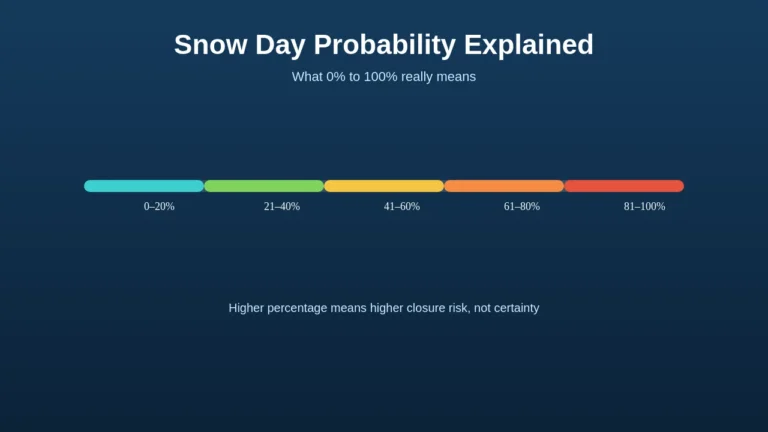
Snowfall alone does not tell the full story. A snow day calculator uses multiple factors to estimate closure chance:
- Snowfall amount
- Ice risk
- Temperature
- Wind speed
- Visibility
- Storm timing
- Local patterns
This gives a clearer picture than snowfall totals alone.
You can check your snow day chance here:
👉 Snow Day Calculator
Summary
Schools usually close when:
- Snow reaches 5–8 inches
- Ice forms on roads
- Storm hits before bus routes
- Wind chill becomes dangerous
Snowfall is important, but it’s only one part of the decision. The safest way to estimate closures is to check a prediction tool that uses real-time weather data.